Why Travel Festivals Differ Across Regions: A Real Guide
Travel festivals are culturally embedded events that reflect the living traditions, economic priorities, and local identities of the communities that create them. That’s why travel festivals differ across regions so dramatically. You can’t compare Rio’s Carnival to Japan’s Obon Festival and expect them to feel the same. They come from completely different places, literally and culturally. Understanding those differences makes you a better traveler and a far more engaged festival guest.
Why do travel festivals differ by region?
Regional festival differences are rooted in living traditions that communities transmit and adapt across generations. UNESCO’s intangible cultural heritage framework defines festivals not as static events but as evolving social practices shaped by local climate, history, and community identity. That framing matters because it tells you something real: a festival in rural Oaxaca and a festival in Seoul are not just geographically different. They are expressions of entirely separate cultural logics.
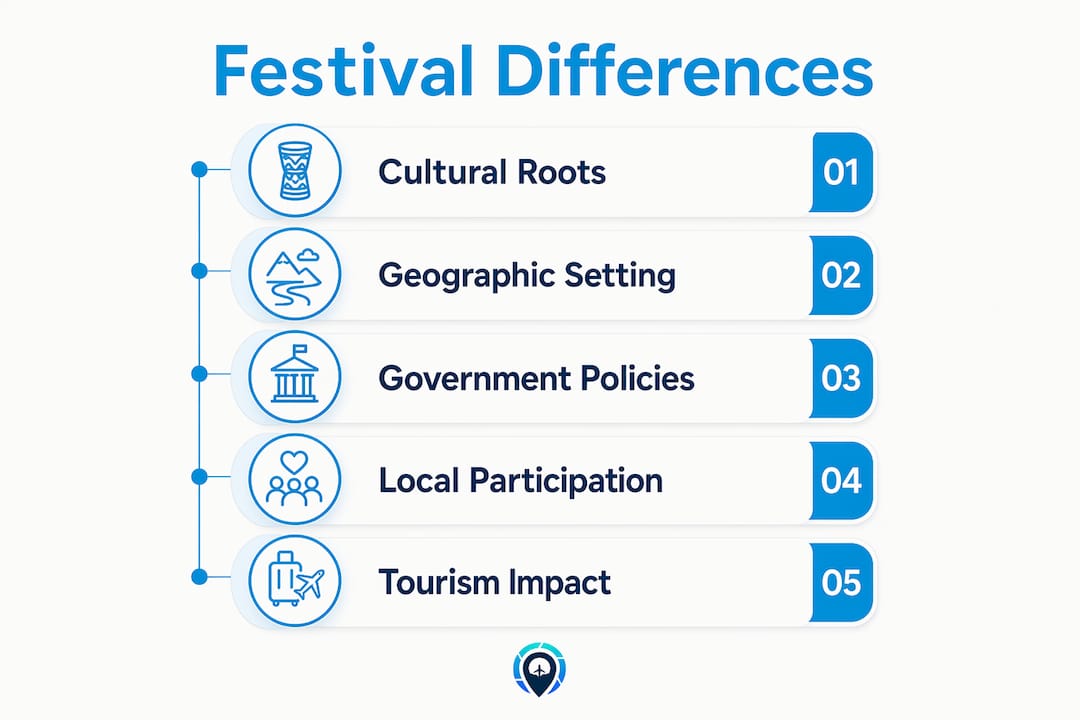
The differences in travel festivals show up in three main ways. First, the rituals themselves vary. Second, who participates and why changes the entire atmosphere. Third, the economic and institutional forces behind each event shape what you actually experience as a visitor. A harvest festival in rural Vietnam is a community ritual. A music festival in a South Korean coastal city may be a government-funded tourism product. Both are real. Both are worth attending. But they require completely different expectations.
Cultural influences on festivals are not just decorative. They determine the structure, timing, and meaning of every element. The Holi festival in India happens in spring because it marks the end of winter and the triumph of good over evil. The Día de los Muertos celebrations in Mexico happen in late october and early november because they align with Catholic All Saints’ Day layered over indigenous Aztec traditions. These are not arbitrary dates or themes. They are the result of centuries of adaptation.
How cultural heritage shapes unique regional celebrations
UNESCO’s intangible heritage framework places festive events within the domain of social practices, rituals, and ceremonial events. This category covers everything from the Carnival of Venice to the Nowruz celebrations across Central Asia. What they share is a transmission process: older generations pass down the knowledge, and younger generations adapt it to fit their current context.
That adaptation is where regional uniqueness gets created. A festival doesn’t stay frozen in time. It absorbs new influences, responds to migration, and shifts with the community’s economic reality. The result is that even festivals with similar origins can look completely different depending on where they land.
Here’s what cultural heritage actually produces in practice across different regions:
- Ritual emphasis : In West African festivals like the Homowo harvest celebration in Ghana, the ritual feeding of ancestors is the centerpiece. The food, the prayers, and the family gathering are not optional extras. They are the festival.
- Seasonal alignment : Many Asian festivals, including the Lantern Festival in China and the Songkran water festival in Thailand, are tied to lunar calendars. The date shifts every year on the Gregorian calendar, which confuses first-time visitors but makes perfect sense within the tradition.
- Community roles : In indigenous festivals across Latin America, specific roles like mask-maker, musician, or ceremonial leader are inherited within families. Outsiders can watch but rarely participate in the core ritual.
- Adaptation over time : The Edinburgh Festival Fringe in Scotland began in 1947 as a protest against the official Edinburgh International Festival. It has since become the world’s largest arts festival. That kind of evolution is exactly what UNESCO describes as living tradition.
Pro Tip: Before attending any regional festival, spend 20 minutes reading about its origin and ritual structure. You’ll spot details that most tourists completely miss, and locals will notice that you noticed.
How does geography affect festival locations and styles?
Geography shapes not just where festivals happen but what kind of festival is even possible. Population density, infrastructure, and proximity to cultural centers all determine whether a festival can grow, attract visitors, or even survive.
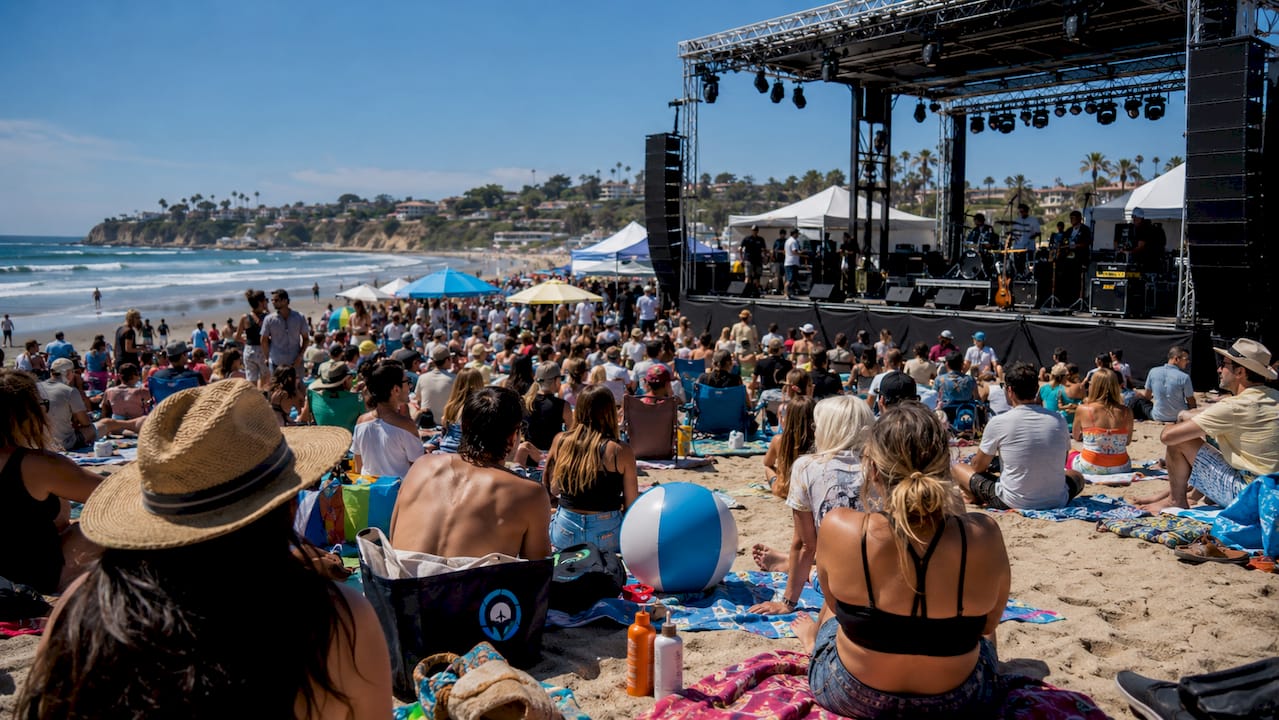
China offers one of the clearest examples of this dynamic. Outdoor music festivals have been spreading from megacities like Beijing and Shanghai into second, third, and even fourth-tier cities, including western inland regions that were previously outside the festival circuit entirely. That diffusion is not random. It follows infrastructure development, rising disposable incomes in smaller cities, and deliberate institutional support.
The Hu Line, a demographic boundary that divides China into a densely populated eastern half and a sparsely populated western half, has historically limited festival development in the west. But institutional and governance factors are now interacting with market forces to push festivals across that line. That’s a big deal for travelers. It means festivals are appearing in places that didn’t have them a decade ago.
| Region type | Festival characteristics | Key driver |
|---|---|---|
| Megacity (tier 1) | Large scale, international acts, high production | Market demand and commercial investment |
| Mid-size city (tier 2–3) | Growing festival scene, mix of local and touring acts | Infrastructure development and rising incomes |
| Rural or inland areas | Community-rooted, smaller scale, traditional focus | Cultural preservation and local identity |
| Coastal tourism zones | Tourism-oriented, multilingual, high visitor volume | Government tourism strategy and geography |
Pro Tip: Festivals in smaller or inland cities often deliver a more authentic experience than their megacity counterparts. The crowds are smaller, the locals are more present, and the cultural context is usually more intact.
What role do government policies play in festival differences?
Government policy is one of the most underappreciated forces shaping regional festival differences. Most travelers assume festivals grow organically from culture. That’s partly true. But in many countries, festivals are also deliberate economic tools.
South Korea is the clearest current example. The Korean government funds global and preliminary global festivals with structured multi-year budgets specifically designed to boost inbound tourism and regional economic growth. Three festivals receive approximately $540,000 annually for three years under the global designation. Preliminary global festivals receive approximately $170,000 annually each. That level of funding changes everything about how a festival operates.
Government designation as a global festival triggers branding investment, infrastructure upgrades, integration into international tourism circuits, and multilingual marketing. The Boryeong Mud Festival and the Andong Mask Dance Festival are both beneficiaries of this kind of support. They’ve adapted their content and marketing specifically for international visitors without abandoning their cultural roots. That balance is hard to achieve, and not every festival manages it.
The economic stakes are real. 95% of festivals in South Korea occur in population-declined areas where local governments use them as economic revitalization strategies. Festivals in these areas prioritize participation and economic impact over spectacle. That’s a fundamentally different design goal than a commercial music festival in a major city.
What this means for you as a traveler:
- Funded festivals tend to have better logistics, more English-language support, and stronger international programming.
- Community-survival festivals tend to feel more genuine but may have fewer visitor-facing amenities.
- Tourism-circuit festivals are often packaged with hotel deals, transport links, and guided experiences.
- Unfunded local festivals can be the most memorable precisely because they weren’t designed for you.
Cultural rituals vs. tourism spectacles: what’s the real difference?
The most useful distinction you can make as a festival traveler is between ritual-focused festivals and tourism-oriented spectacles. Both are valid. But they deliver completely different experiences, and confusing one for the other leads to disappointment.
Community-preserved ritual festivals tend to feel embedded in place. The locals are not performing for you. They are doing something that matters to them, and you happen to be watching. Event boundaries are enforced differently here. You may not be allowed into certain spaces, certain ceremonies, or certain moments. That’s not exclusion. That’s the festival protecting its own integrity.
Tourism spectacles operate on the opposite logic. The visitor is the point. The Carnival in Rio de Janeiro draws over 2 million people per day during peak days. The infrastructure, the samba school performances, the ticketed grandstand seating, all of it is designed to deliver an experience to people who flew in from somewhere else. That’s not a criticism. It’s just a different kind of event.
The atmosphere shifts accordingly. Ritual festivals feel participatory even when you’re an observer. Tourism spectacles feel produced even when they’re genuinely exciting. Successful global festivals focus on experience density and emotional impact rather than scale alone. The ones that get this right, like the Andong Mask Dance Festival in South Korea, manage to feel both accessible to visitors and meaningful to locals.
Key Takeaways
Regional festival differences are driven by cultural heritage, geography, government policy, and the fundamental question of who the festival is actually for.
| Point | Details |
|---|---|
| Culture shapes structure | UNESCO defines festivals as living traditions that communities adapt across generations, not fixed events. |
| Geography drives diffusion | Festivals spread from megacities to smaller cities as infrastructure and incomes develop, as seen in China. |
| Policy changes the product | South Korea’s government funding transforms regional festivals into internationally packaged tourism experiences. |
| Ritual vs. spectacle | Community ritual festivals enforce boundaries and feel embedded; tourism spectacles are designed for visitor consumption. |
| Smaller cities, bigger authenticity | Festivals in lower-tier cities and rural areas often preserve stronger cultural context than their megacity counterparts. |
What I’ve learned from attending festivals on four continents
Here’s the honest truth: I used to show up to festivals the same way I showed up to theme parks. Get in, see the main attractions, take the photos, leave. It took a genuinely confusing experience at a small harvest festival in rural Thailand to change that. I had no idea what was happening, I couldn’t read any of the signs, and the locals were clearly not performing for me. I was just there. And it was one of the best festival experiences I’ve ever had.
The festivals that have stayed with me longest are the ones where I did the work beforehand. Reading about the cultural significance of festivals before you arrive isn’t just useful. It changes what you see. You start noticing the ritual structure, the community roles, the moments that are sacred versus the moments that are open. That awareness makes you a better guest.
My practical advice: if a festival has a government tourism office running it, that’s not a red flag. It just means you need to look a little harder for the authentic core underneath the packaging. It’s almost always there. The Andong Mask Dance Festival in South Korea has serious government backing, and it still delivers genuine cultural weight if you get away from the main stage. The music festival geography of a place tells you a lot about what kind of experience you’ll find there.
Don’t be afraid of festivals that weren’t designed for you. Those are often the ones worth the most effort.
— Justin
Traveling Portrait’s guides for your next festival adventure
Attending a regional festival is one thing. Truly capturing it, in photos and in memory, is another skill entirely.
Traveling Portrait has built out destination guides and hands-on resources specifically for travelers who want to go deeper than the surface. The travel photography workshop teaches you how to document festival culture with sensitivity and real artistic skill, whether you’re shooting a lantern ceremony in Asia or a street parade in Europe. For travelers ready to plan their next festival trip, the adventure travel guide covers cultural immersion travel in detail, including how to find and attend regional festivals that most tourists never hear about. Festival travel done right is one of the most rewarding things you can do with a passport.
FAQ
Why do festivals vary so much between countries?
Festivals reflect the specific cultural heritage, history, and social practices of the communities that created them. UNESCO identifies these as living traditions that each region transmits and adapts differently over time.
What makes a regional festival different from a tourism festival?
Regional festivals center on community ritual and local participation, while tourism festivals are designed primarily for visitor consumption. The difference shows up in event boundaries, atmosphere, and how locals engage with the event.
How does government funding change a festival?
Government designation, like South Korea’s global festival program, brings multi-year budgets, infrastructure investment, and integration into international tourism circuits. It reshapes programming and visitor flow in measurable ways.
Are festivals in smaller cities worth visiting?
Festivals in smaller or lower-tier cities often preserve stronger cultural context than those in major urban centers. Research on China’s festival diffusion shows that as events spread to smaller cities, they frequently retain more community-rooted characteristics.
How can I tell if a festival is authentic?
Look at who participates and why. Ritual-focused festivals have locals as active participants rather than performers for tourists. If the community is doing something meaningful for itself and you’re invited to observe, that’s a strong sign of cultural authenticity.
Recommended
Other Posts You Might Like