Why Camping Festivals Differ From Hotels: Pick the Right Stay
Choose camping when you already own gear and can drive to the festival. Choose a hotel when you’re flying in, traveling with kids, or need reliable sleep and showers to function the next day. That’s the short version. The longer version is where it gets interesting, because the gap between a $40 campsite fee and a $300 hotel room isn’t always what it looks like once you actually add in gear amortization, festival vehicle passes, shower tokens, and extra on-site costs. Be sure to calculate total trip cost including all these factors before making your choice.
Here’s what actually drives the decision:
- You own gear and can drive it there. If you’ve already got a tent, sleeping bag, and a cooler, camping is almost always the cheaper call across multiple trips.
- Sleep and recovery matter to you. Hotel beds, private bathrooms, and air conditioning make a real difference after 10 hours on your feet.
- Proximity to the stages. On-site camping means you roll out of your tent and you’re already there. Hotels often mean shuttles, rideshares, and surge pricing at 2 AM.
- Your group type. Solo travelers and friend groups tend to thrive in campgrounds. Families with young kids or anyone with mobility needs often find hotels worth every extra dollar.
- Weather and evacuation risk. Camping in a severe storm is genuinely dangerous. Hotels give you a solid roof and a clear evacuation path. If the forecast looks rough, that matters.
Table of Contents
- How do hotels, tent camping, and RV/glamping compare at a glance?
- What do hotels near festivals actually give you?
- How do you calculate the true cost of camping vs. a hotel?
- How does logistics actually differ between camping and hotels?
- What about safety, privacy, and accessibility?
- Your attendee-tested festival camping packing checklist
- Who should pick which option?
- What do real attendees say, and which myths hold up?
- Key Takeaways
- The view from the field
- Useful sources and where to check festival rules and pricing
How do hotels, tent camping, and RV/glamping compare at a glance?
Hotels win for comfort and security. Tent camping wins for atmosphere and cost (when gear is already owned). RV or glamping splits the difference, and for groups replacing multiple hotel rooms, it can actually beat both on per-person cost when you factor in cooking your own meals.
What do hotels near festivals actually give you?
The honest answer: predictability. A hotel room means a real bed, a private bathroom, climate control, and housekeeping. You don’t have to think about any of it. After a 12-hour festival day, that kind of reliable comfort genuinely helps recovery and reduces the impulse spending that happens when you’re exhausted and just need something cold to drink.
What hotels don’t advertise as loudly:
- Resort and destination fees — tacked onto the nightly rate, sometimes $30–$50 extra per night near major festival venues.
Hotels become the clear winner when you’re flying in (no gear to haul), traveling with young kids or elderly family members, or attending a festival with poor on-site camping infrastructure. If you have a mobility need, a hotel is almost always the more practical choice, full stop.
How do you calculate the true cost of camping vs. a hotel?
This is where most people get it wrong. They compare the campsite fee to the hotel rate and stop there. The real comparison includes everything.
Full cost categories
Camping: campsite pass, vehicle/car pass (often $30–$80 extra), tent and sleeping gear amortized per trip, sleeping pad, cooler, portable charger, shower tokens or locker fees, ice, food and cooking supplies, any last-minute on-site purchases.
Hotel: nightly rate, taxes (15–18% in many US cities), resort/destination fees, parking, shuttle or rideshare costs to and from the festival each day.
Gear amortization: the key calculation
Treat gear cost as a per-trip share, not a one-time hit. The formula: camping total = campsite fees + (gear cost ÷ expected uses).
| Gear item | Purchase cost | Expected uses | Per-trip cost |
|---|---|---|---|
| 3-person tent | $180 | 10 trips | $18 |
| Sleeping bag | $90 | 15 trips | $6 |
| Sleeping pad | $60 | 15 trips | $4 |
| Cooler | $50 | 20 trips | $2.50 |
| Total gear per trip | $30.50 |
Sample 3-day festival comparison (two people)
| Cost item | Camping | Hotel |
|---|---|---|
| Accommodation | $120 (3 nights x $40 campsite) | $900 (3 nights x $300 hotel room) |
| Vehicle pass | $60 | $60 |
| Gear (amortized) | $61 | $0 |
| Taxes & fees | $0 | $144 (16% of hotel subtotal) |
| Shuttle/rideshare | $0 | $90 (3 days x $30) |
| Ice, showers, misc. | $40 | $0 |
| Total | $281 | $1,194 |
That’s a significant gap. But it assumes you already own the gear. If you’re buying everything new for one trip, add the full gear cost to the camping column and the math shifts considerably.
Pro Tip: Apply the quick decision rule: if you can drive to the festival and you’ll use the gear at least 3–4 more times, amortize it and camping almost always wins. If you’re flying in or buying gear for a single trip, run the full numbers before assuming camping is cheaper. Hidden fees and gear costs often narrow the gap more than people expect.
How does logistics actually differ between camping and hotels?
The day-by-day experience is where the differences really stack up. Here’s how arrival, festival days, and departure typically play out for each option.
- Arrival day (hotel): — Check-in windows are usually 3–4 PM. If you arrive early, you may be waiting in a lobby with your luggage. Some hotels near festival venues offer luggage storage, which helps. Book a hotel with a confirmed shuttle service or you’ll be figuring out transport on the fly.
- Departure day (hotel): Check-out is typically 11 AM. You’re on a schedule, but you leave clean, rested, and with no gear to haul. For planning travel around festival dates, booking a hotel with a late checkout option is worth the small upcharge.
What about safety, privacy, and accessibility?
Tent camping has a real security gap compared to a hotel room. A tent zipper with a small luggage lock is better than nothing, but it’s not a locked door. REI’s festival camping guidance recommends keeping valuables in a locked vehicle rather than your tent, using a small combination lock on tent zippers, and never leaving cash or electronics visible inside.
On weather and evacuation: Hotels have fire evacuation plans, solid roofs, and climate control. Festival campgrounds have weather protocols, but when a serious storm hits, you’re in a field. Electric Forest and similar large festivals have documented weather evacuations where attendees had to shelter in place or leave the grounds entirely. If severe weather is forecast for your festival weekend, a hotel gives you a genuinely safer option.
For families with young kids, the calculus shifts pretty clearly toward hotels. Family festival camping can be a rich, memorable experience, but it’s also logistically demanding: sun protection, snacks, keeping track of children in large crowds, and managing tired kids at the end of a long day. Hotels give families a private, controlled space to decompress. For anyone with mobility needs, check the festival’s accessibility page before assuming camping is viable. Many campgrounds have uneven terrain, long walks to facilities, and limited accessible bathrooms.
For solo travelers and friend groups without mobility concerns, camping’s security risks are manageable with the right prep. The communal atmosphere is genuinely worth it for most people in that category.
Your attendee-tested festival camping packing checklist
Good packing is the difference between a great weekend and a miserable one. Here’s what experienced campers actually bring, organized by category.
Shelter & sleep
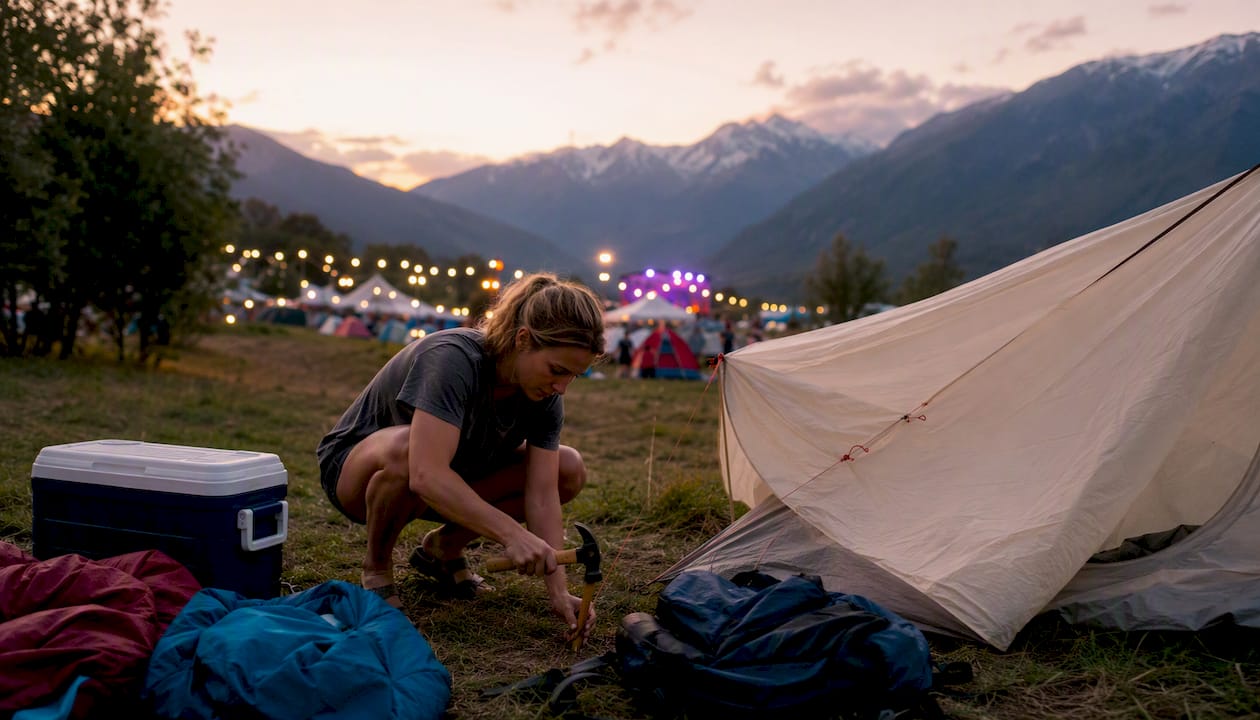
- Freestanding tent (practice pitching it at home first)
- Sleeping bag rated for the expected overnight low
- Sleeping pad or air mattress
- Tent footprint or ground tarp
Shade & cooling
- Pop-up canopy or shade tarp for daytime camp use
- Portable fan (battery-powered)
- Cooling towels
Hygiene
- Biodegradable soap and shampoo
- Dry shampoo (a genuine lifesaver by day two)
- Wet wipes for quick cleanups
- Shower tokens if the festival sells them in advance (they often sell out)
- Hand sanitizer
Power & connectivity
- High-capacity power bank (20,000 mAh or larger)
- Solar charger as a backup
- Short charging cables for sharing
Food & storage
- Hard-sided cooler with a lock
- Reusable water bottle (large)
- Easy-prep food for mornings (oatmeal packets, granola bars)
Security
- Small combination locks for tent zippers and cooler
- Fanny pack for valuables at the festival
- Laminated camp address card (campsite row/number)
Photo gear basics
- Lightweight travel tripod
- Weatherproof camera cover or dry bag
- Extra batteries and memory cards
Pro Tip: Mark your tent with a distinctive flag or colored ribbon on a tall pole. At 1 AM in a sea of identical tents, you’ll be very glad you did. For a full gear breakdown, Traveling Portrait’s travel photography gear guide covers lightweight options that work just as well at festivals as they do on the road.
For photographers specifically: rent heavy or specialty gear locally rather than hauling it. A lightweight tripod and a weatherproof cover for your camera body are the two items most worth owning outright. Everything else can often be rented or improvised.
Who should pick which option?
Solo attendee flying in: Hotel, no question. No gear to haul, no car to park, and you need a reliable base. The cost difference shrinks fast when you’re not amortizing gear.
Group of four friends with gear and a car: Camping almost always wins. Split the campsite and vehicle pass four ways, cook some meals, and the savings are substantial. The communal vibe is a bonus.
Family with kids under 10: Hotel, or VIP glamping if the festival offers it. The logistics of managing young children in a general campground are exhausting, and the family-travel planning considerations around safety and comfort tip the balance clearly toward structured accommodation.
Photographer traveling with gear: Car camping or VIP camping if you can drive. You need your gear accessible and secure. A lockable vehicle next to your pitch is the best setup. If you’re flying, a hotel with secure storage is safer for expensive equipment.
First-time festival attendee: Hotel for your first trip, or at minimum VIP camping with better facilities. Get the lay of the land before committing to a general campsite. The learning curve is real.
Quick decision checklist:
- [ ] Do I own reliable camping gear?
- [ ] Can I drive (not fly) to the festival?
- [ ] Will I use this gear again within the next year?
- [ ] Am I comfortable with outdoor sleeping and shared bathrooms?
- [ ] Is my group mobile and without young children or accessibility needs?
If you checked all five, camping is probably your call. If you checked two or fewer, book the hotel.
What do real attendees say, and which myths hold up?
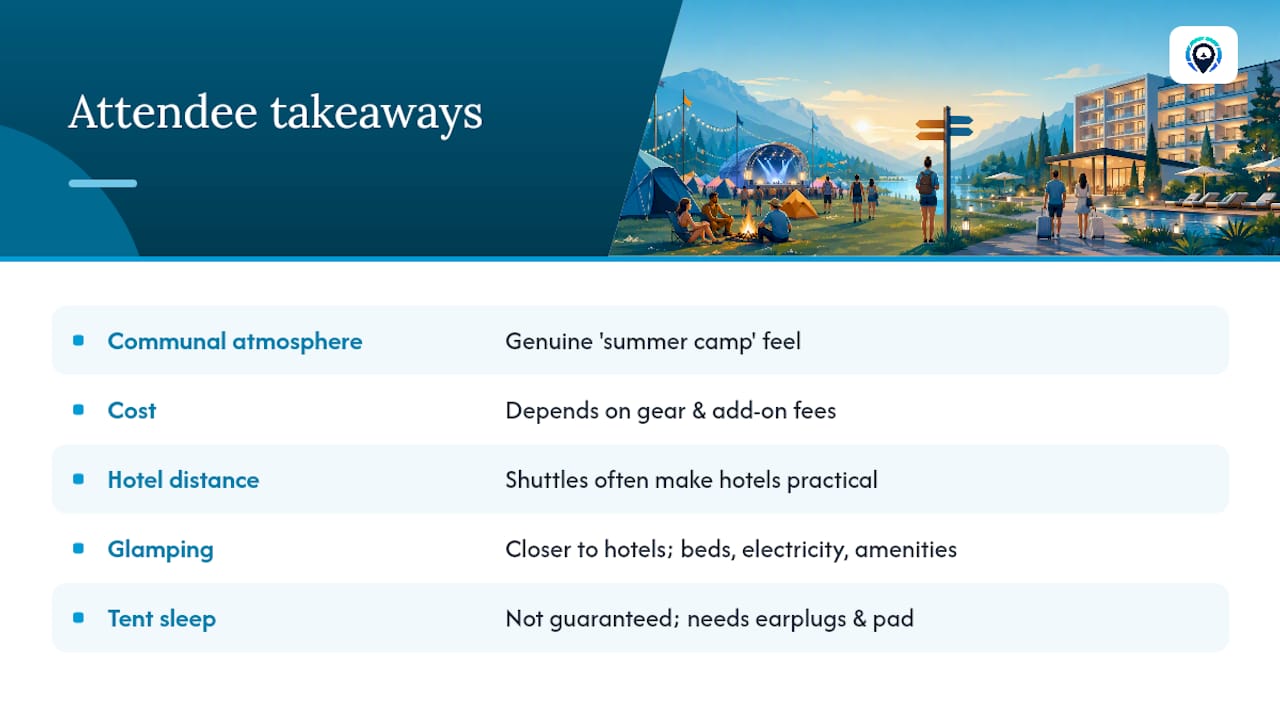
The communal atmosphere gets talked about constantly, and it’s not hype. First-time Electric Forest attendees describe a “summer camp” feeling that genuinely surprised them, with strangers sharing food, spontaneous late-night conversations, and a sense of shared experience that no hotel lobby replicates. That part is real.
But some of the myths don’t hold up as well.
“Camping is always cheaper.” Reality: it depends entirely on whether you own gear, how you’re traveling, and what add-on fees the festival charges. Vehicle passes, shower tokens, ice, and last-minute on-site purchases add up fast. For a first-time camper buying all new gear for a single trip, a mid-range hotel can actually be the cheaper option once you run the full numbers.
“Hotels near festivals are too far away to be practical.” Not always. Many major US festivals have official hotel partners with dedicated shuttle services. If the shuttle is included or cheap, the distance problem largely disappears.
“Glamping is just expensive camping.” Glamping at a festival is closer to a hotel experience than a camping one. Pre-pitched bell tents with real beds, electricity, and access to better bathrooms are a genuine middle ground, though the price reflects it.
“You’ll sleep fine in a tent.” Experienced campers know this takes practice. Noise, light, and temperature all affect sleep quality in a campground. Earplugs, a sleep mask, and a quality sleeping pad make a bigger difference than most first-timers expect.
The emotional and experiential differences between festival stay types are worth understanding before you commit, because the right choice isn’t just financial.
Key Takeaways
Festival camping and hotel stays serve genuinely different attendees: camping wins on cost and atmosphere when you own gear and can drive, while hotels win on comfort, safety, and convenience for fly-ins, families, and first-timers.
| Point | Details |
|---|---|
| Gear amortization changes the math | Divide gear cost by expected uses to find the true per-trip camping cost before comparing to hotel rates. |
| Hotels carry hidden fees | Resort fees, taxes, parking, and rideshare costs can add over $290 to a typical 3-night festival hotel stay beyond the nightly rate. |
| Weather risk is real for campers | Severe weather at a festival campground is a genuine safety concern; hotels offer a more reliable shelter option. |
| Group type drives the decision | Friend groups with gear and a car favor camping; families with young kids and fly-in travelers favor hotels. |
| First-timers should start cautiously | VIP camping or a hotel for your first festival reduces friction and helps you learn the logistics before going full campsite. |
The view from the field
There’s a version of this debate that gets oversimplified constantly: “camping is for the real fans, hotels are for the soft ones.” That framing is nonsense, and it leads people to make expensive, uncomfortable decisions based on social pressure rather than practical sense.
What I’ve found, after covering festivals and outdoor events through the lens of travel photography, is that the right choice is almost always the one that lets you show up at the stages with energy. A photographer lugging $3,000 of gear through a muddy campground at 6 AM after three hours of sleep isn’t capturing great shots. A family with a six-year-old who hasn’t slept isn’t having a magical experience.
The camping experience at its best, the communal vibe, the proximity, the spontaneous 2 AM conversations with strangers, is genuinely something special. But it requires preparation, the right gear, and ideally some prior experience. The first-time camper accounts that end in misery almost always share one thing: they underestimated the logistics and overestimated their comfort threshold.
Run the cost math honestly, using gear amortization. Match the choice to your actual group, not the group you wish you were. And if you’re a photographer, think hard about gear security before you commit to a general campsite. Traveling Portrait’s travel photography workshop covers festival and outdoor event photography in detail, including how to manage gear in exactly these conditions.
The best festival experience is the one you actually recover from.
Useful sources and where to check festival rules and pricing
Before you book anything, go to the festival’s official website first. That’s where you’ll find the actual camping rules, vehicle pass requirements, shower facility details, and shuttle schedules. These details change year to year and vary significantly between events.
- Festival camping tips & gear | REI Expert Advice
- Hotel vs Camping for Festival Season: Which option actually s
- Camping vs Hotel Cost Calculator
- Hotel vs. Camping road trip cost comparison
- Defying All Expectations: My First Time at Electric Forest
- Live report: Camp Bestival 2026
- Camping vs Hotels: Choosing the best stay option for your next trip
For eco-conscious campers, mindful travel packing tips are worth a read before you stock up on single-use supplies. Leave-no-trace principles apply at festival campgrounds just as much as they do in the backcountry.
Recommended
Other Posts You Might Like