

Traveling Sustainably on a Budget: Real Money-Saving Tips
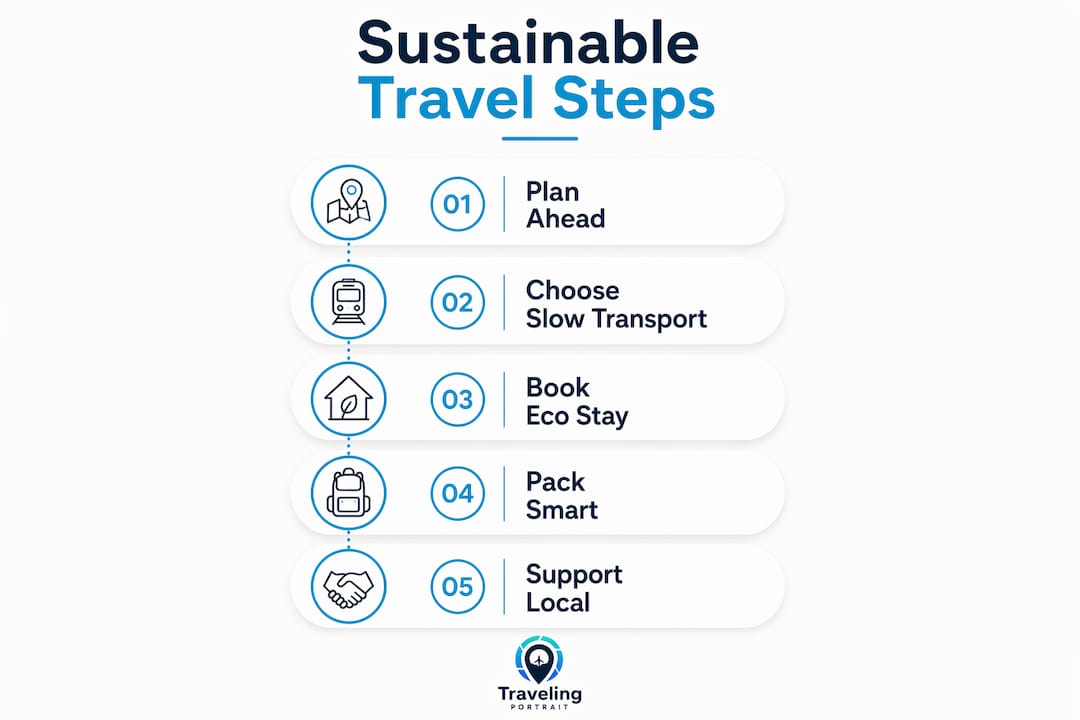
You can cut your travel emissions and costs at the same time. The trick is combining slow travel, walkable base cities, low-impact transport, and locally run stays. These aren’t sacrifices — they’re genuinely the cheaper way to travel. Sustainable actions like eating local, walking, and packing light reduce both your daily spend and your footprint simultaneously, which is the whole point of this guide.
TL;DR checklist — start here:
- Pack carry-on only (skip checked baggage fees)
- Choose trains, buses, or ferries over short-haul flights
- Stay in guesthouses, hostels, or homestays
- Eat at local markets and family-run spots
- Travel in shoulder season to find notably cheaper accommodation
- Bring a reusable water bottle, tote, and travel utensils
- Base yourself in one city for a week or more
- Offset only after reducing first
Pro Tip: Swapping a short domestic flight for an overnight train saves you a hotel night and cuts emissions from the most fuel-intensive phases of air travel — takeoffs and landings — in one move.
Table of Contents
- What are the best strategies for traveling sustainably on a budget?
- When flying is unavoidable, use the NERD framework
- How do you find budget-friendly sustainable accommodations?
- What should you pack to save money and reduce waste?
- How do you plan and budget a sustainable low-cost trip?
- Key Takeaways
- Sustainable travel looks different through a camera lens
- Useful sources and next-step reading
What are the best strategies for traveling sustainably on a budget?
Layering multiple small sustainable actions — shoulder-season dates, long stays in walkable cities, cooking some meals, and using rail — multiplies your savings and slashes per-day emissions. Here are the top 10 strategies, ranked by impact.
-
Slow travel: base yourself in one place for 1–4 weeks. Fewer transit legs means lower emissions and lower cost. Book a weekly rate at a guesthouse, learn the neighborhood, and let the place come to you. Negotiate a discount for stays longer than five nights — most small hosts will say yes.
-
Pack carry-on only. Checked baggage fees add up fast, and a lighter bag makes buses, trains, and bikes practical. Roll clothes instead of folding, and choose quick-dry fabrics that work for multiple days.
-
Choose trains, buses, and ferries over short flights. Surface transport emits a fraction of what flying does, and the ticket price is often lower too. Book rail passes or point-to-point tickets early for the best fares.
-
Stay in locally run guesthouses, hostels, or homestays. Your money goes directly to the community rather than a multinational chain. Dorm beds in budget-friendly destinations can run as low as $8 per night, with private rooms at $15–$20. Bungalows and homestays are also available at around $30 per night in some regions, as in the Jozani area of Tanzania.
-
Travel in shoulder season. Accommodation prices drop 30–40% compared to peak. Crowds thin out, and your visit spreads tourism impact more evenly across the year.
-
Eat at local markets and family-run restaurants. Street food and market meals are almost always cheaper than tourist-facing restaurants, and supporting local food economies keeps money in the community. Cook in your guesthouse kitchen a few nights a week to cut costs further.
-
Bring reusables everywhere. A refillable water bottle, cloth tote, and a set of travel utensils eliminate repeated single-use purchases. The upfront cost pays back within a few days of travel.
-
Choose free and low-cost activities. Hiking national park trails, visiting local markets, attending community events, and exploring neighborhoods on foot cost almost nothing. Many of the best experiences do.
-
Buy local crafts and use local guides. Purchasing directly from artisans and booking community-run tours keeps spending in the local economy. Local experiences also tend to be more memorable than packaged tourist options.
-
Verify green claims before booking. Look for third-party certifications, owner statements about water and energy practices, and guest reviews that mention sustainability. Greenwashing is real — a quick search for a property’s certifications takes two minutes.
Pro Tip: When booking a local guided walk or wildlife tour, ask whether a group rate is available. Many community guides will discount for groups of three or more, and splitting the cost makes a $40 guided walk $13 per person.
When flying is unavoidable, use the NERD framework
The NERD framework from the World Wildlife Fund is the clearest shorthand for reducing flight emissions: N ewer aircraft, E conomy class, R egular/non-stop routes, D irect flights. Follow it whenever you can’t avoid flying.
- Newer aircraft burn significantly less fuel per passenger. When searching flights, check the aircraft type — the Boeing 787 Dreamliner and Airbus A350 are among the most fuel-efficient long-haul options currently in service.
- Economy class has a much smaller carbon footprint per seat than business or first class, because economy passengers share the plane’s emissions across more seats.
- Regular/non-stop routes avoid the extra takeoffs and landings that are the most fuel-intensive phases of any flight. A non-stop may cost a little more than a connection, but it saves time and emissions.
- Direct flights eliminate layover legs entirely. When a connection is unavoidable, choose the one with the shortest layover in a hub that doesn’t require a significant detour.
One practical combination: fly long-haul non-stop to a hub, then switch to regional rail for the rest of the journey. You get the efficiency of a modern wide-body aircraft for the big crossing, and a train handles the final leg at a fraction of the emissions and often a lower ticket price.
On offsets: they’re imperfect, but verified offset programs contribute positively when paired with genuine reduction. Prioritize reducing first, then offset what you can’t avoid through a certified program like Gold Standard.
Pro Tip: Use Google Flights’ emissions estimates to compare routes before booking. The difference between a fuel-efficient non-stop on a 787 and a two-stop itinerary on older aircraft can be significant — and the non-stop is often competitively priced.
How do you find budget-friendly sustainable accommodations?
Locally run guesthouses, hostels, homestays, and small family-run properties almost always deliver the best budget-to-sustainability ratio. They keep your money in the community, tend to have smaller environmental footprints than large hotels, and often cost far less per night. As experts note, treating a destination as someone’s home — and choosing stays that support local culture — is the foundation of responsible travel.
How to verify green claims:
- Check for third-party certifications (Green Key, EarthCheck, Rainforest Alliance)
- Read guest reviews for mentions of solar power, water conservation, or composting
- Look at the property’s own description for specifics, not just buzzwords like “eco-friendly”
- Ask the host directly about their water and energy practices — genuine operators are happy to answer
Both Booking.com and Hostelworld let you filter by property type and read detailed guest reviews, making it easier to spot genuinely community-run options versus greenwashed marketing. Use them as search tools, then book directly with the property when possible to save the host the commission.
Sample nightly price ranges by accommodation type:
| Category | Typical nightly range | What’s usually included |
|---|---|---|
| Dorm hostel bed | $8–$20 | Shared bathroom, common kitchen, lockers |
| Private guesthouse room | $15–$20 | Private room, often breakfast |
| Homestay | $20–$30 | Room, meals, local knowledge |
| Bungalow | $30 | Standalone option — see Jozani, Tanzania example |
| Farm stay | $30–$40 | Room, farm activities, often meals |
| Budget eco-lodge | $30–$50 | Private cabin, guided activities |

The Jozani area of Tanzania is a useful real-world example: guesthouses near the forest run $8–$30 per night, and a full day’s budget including food, transport, and the forest entry fee can stay around $30–$50. Shoulder-season rates in destinations like this drop significantly from peak pricing, which is a meaningful saving on a tight budget. For more on finding sustainably managed stays, Traveling Portrait’s guide on eco-adventure travel covers how to identify properties that genuinely support local communities.
What should you pack to save money and reduce waste?
Pack light, pack multi-use, and go carry-on only whenever the trip allows. A single carry-on bag saves you $30–$60 per flight leg in checked baggage fees on most U.S. carriers, and it makes buses, trains, and bikes genuinely practical rather than a hassle.
Core sustainable packing list:
- Reusable water bottle (collapsible saves space)
- Travel utensils and a small cloth tote
- Quick-dry, lightweight clothing (3–4 pieces that mix and match)
- A small repair kit (needle, thread, patches) for extending gear life
- eSIM or unlocked phone to avoid single-use SIM packaging
- Digital boarding passes and offline maps (cuts printed waste and roaming costs)
- Small power bank or solar charger
Digital travel tools like eSIMs and mobile boarding passes eliminate repeated local SIM purchases and printed guide costs while cutting single-use plastic packaging. Over a multi-country trip, that’s a real saving.
For photographers traveling with Traveling Portrait, the gear question is always about weight versus capability. A mirrorless body with two versatile primes (a 24mm and a 50mm equivalent) covers most travel scenarios and weighs far less than a DSLR kit with multiple zooms. A lightweight travel tripod or a small GorillaPod handles long exposures without the bulk. Check out Traveling Portrait’s travel gear guide for specific lightweight recommendations that won’t slow you down on public transit.
Replacing single-use plastics with washable alternatives — a silicone bag instead of zip-locks, a bamboo toothbrush, a solid shampoo bar — costs more upfront but saves money across a long trip and eliminates a lot of small purchases along the way.
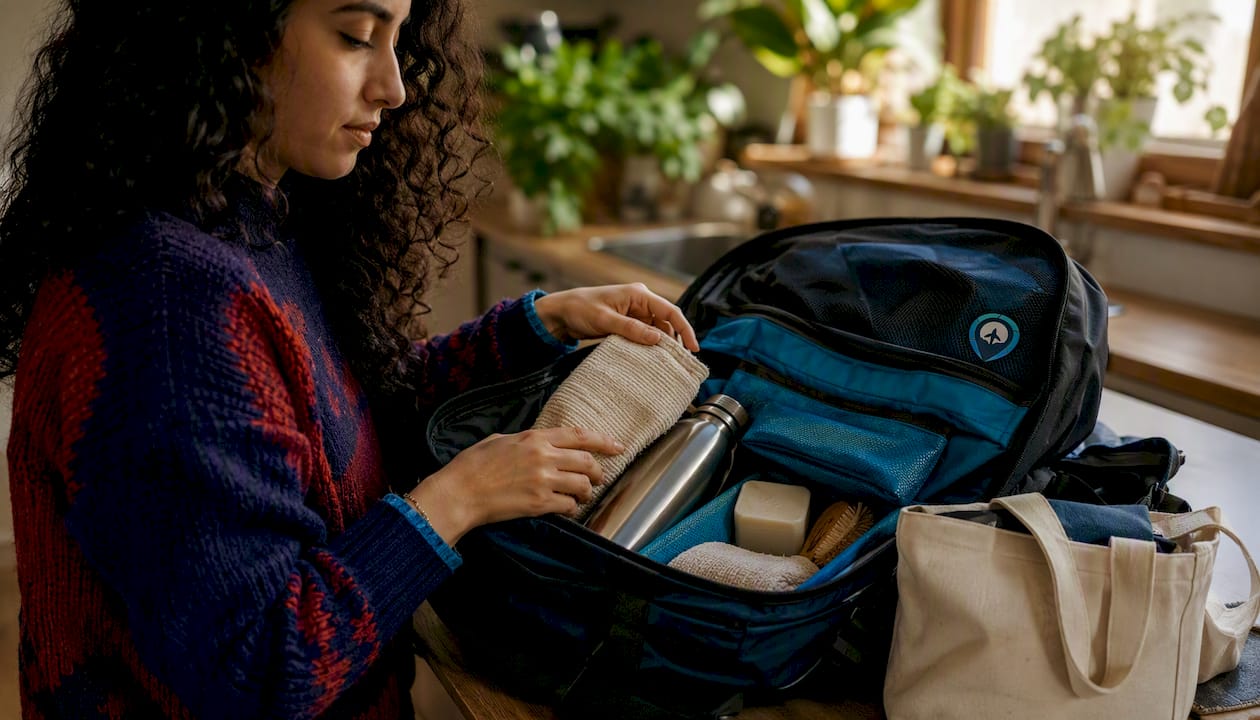
Pro Tip: Wear your heaviest items on travel days (boots, jacket, camera) to keep your bag under the carry-on weight limit. It sounds obvious, but it’s the move that keeps you from checking a bag at the gate.
How do you plan and budget a sustainable low-cost trip?
A six-step planning checklist keeps the process simple and the costs honest.
- Pick a base city and your dates. Choose a walkable city with good rail or bus connections. Shoulder season (typically one to two months before or after peak) cuts accommodation costs by 30–40%.
- Set a carbon and cash budget. Decide upfront how many flight legs you’re willing to take and what your daily spend ceiling is. Writing it down makes trade-offs easier.
- Prioritize surface transport. Map your route by train or bus first. Only add a flight when the time cost of surface travel is genuinely prohibitive.
- Book local stays with kitchen access. A guesthouse or hostel with a shared kitchen lets you cook two or three meals a week, which cuts food costs significantly.
- Schedule low-cost, low-impact activities. Hiking, free museum days, local markets, and neighborhood walks should make up the bulk of your itinerary.
- Leave a buffer for local initiatives. Reserve 5–10% of your budget for spontaneous community purchases — a local guide, a craft from an artisan, a community-run tour.
For long-distance planning across multiple regions, Traveling Portrait’s budget travel planning guide covers slow-travel tactics in detail.
Sample daily budget for a sustainable budget trip:
| Category | Budget range per day | Notes |
|---|---|---|
| Transport (local) | $2–$8 | Bus, metro, bike rental |
| Accommodation | $12–$30 | Hostel dorm to private guesthouse |
| Food | $10–$20 | Mix of market meals and self-catering |
| Activities | $5–$15 | Free walks, low-cost entry fees |
| Local transfers | $3–$10 | Shared taxis, ferries |
| Contingency | $5–$10 | Local crafts, tips, unexpected costs |
| Total | $15–$35 | Varies by destination and season |
A few decision rules worth keeping in mind: if a rail journey takes under eight hours, it almost always beats flying on both cost and emissions. An extra night in a cheap guesthouse often costs less than the transit to your next destination, especially when you factor in airport transfers. And slow travel — staying one to four weeks in a single place — reduces per-day transit and lodging costs while giving you time to find the best local spots rather than rushing through highlights.
On safety and health: budget sustainable travel often means more time on public transport and in locally run accommodations. Carry a basic first-aid kit, keep digital copies of your documents, and research local health requirements before you go. Travel insurance that covers medical evacuation is worth the cost even on a tight budget.
Key Takeaways
Traveling sustainably on a budget works best when you layer slow travel, surface transport, local stays, and shoulder-season timing — each choice saves money and cuts emissions at the same time.
| Point | Details |
|---|---|
| Slow travel saves the most | Basing yourself for 1–4 weeks cuts per-day transit costs and emissions more than any single swap. |
| Shoulder season cuts accommodation costs substantially; booking one to two months before or after peak can secure the same stay for less. | |
| NERD framework for unavoidable flights | Choose Newer aircraft, Economy class, Regular/non-stop, and Direct routes to minimize flight emissions. |
| Night trains double as lodging | Overnight rail can save money per night compared with paid accommodation on the same route. |
| Reusables pay back fast | A water bottle, tote, and travel utensils eliminate repeated small purchases within days of travel. |
Sustainable travel looks different through a camera lens
There’s a version of sustainable travel that gets talked about a lot — the checklist version, where you tick off your reusable bottle and call it done. That’s fine as a starting point, but it misses the more interesting argument.
The places that reward slow, low-impact travel are almost always the places worth photographing. When you base yourself in a neighborhood for two weeks instead of rushing through five cities in ten days, you start to see the light at the right time. You find the market that opens at 6 AM. You learn which street corner catches the late afternoon gold. None of that happens from a tour bus.
From a budget perspective, the same logic applies. The traveler who spends three weeks in one region, uses local transport, eats where locals eat, and stays in a family-run guesthouse almost always comes home having spent less than the traveler who tried to cover twice the ground. The math just works out that way.
For photographers specifically: leave the zoom lens at home more often than you think you should. A single prime forces you to move, to get closer, to actually engage with a scene rather than standing back and cropping. That constraint produces better images and a lighter bag — which means you’ll actually take the bus instead of a taxi, and walk the extra kilometer instead of calling a ride.
Traveling Portrait’s travel photography workshops are built around exactly this approach: small groups, slow itineraries, and destinations chosen for depth rather than volume. It’s the same philosophy applied to learning.
The honest take on sustainable travel is that it’s not a sacrifice. It’s just a different set of priorities — and those priorities tend to produce better trips, better images, and a lighter wallet impact than the alternative.
Useful sources and next-step reading
A few resources worth bookmarking as you plan your trip:
- World Wildlife Fund — Responsible Travel Tips: The primary source for the NERD flight framework. Clear, practical, and free.
- BBC Travel — 8 Ways to Travel More Sustainably: Good framing on treating destinations as people’s homes and supporting local economies.
- Economad Travel — Budget Travel Tips: Solid breakdown of slow travel, night trains, and the real cost savings of rail-first planning.
- Ecobnb — Sustainable Travel Tips: Practical checklist for reusables, digital tools, and greener stays.
- tangyOcean — Jozani on a Budget: A real-world example of budget sustainable travel near a protected area, with actual price data.
- Condé Nast Traveler — How to Travel Sustainably: Balanced take on carbon offsets and what verified programs actually deliver.
- Sustainable Travel International: A nonprofit with destination guides, certification information, and planning resources.
- WTTC — Consumer Sustainability Report: Research on traveler attitudes toward sustainability and cost — useful context for understanding where the industry is heading.
“Regenerative travel — looking for positive impact opportunities like volunteer-based stays, citizen science, and community conservation — can be low-cost and high-impact when organized locally.” — BBC Travel
For deeper planning, Traveling Portrait’s adventure travel guide covers the philosophy and practicalities of low-impact adventure travel in detail.
Recommended
Other Posts You Might Like