
Physical Conditioning for Adventures: Your 2026 Guide
Physical conditioning is the foundation of every successful outdoor adventure, and the role of physical conditioning in adventures goes far beyond just “getting fit.” Research links physical inactivity to a 72% higher risk of hospitalization and a 25% increase in mortality. That statistic tells you everything about the stakes. Whether you’re planning an alpine trek, a multi-day backpacking trip, or an adventure race, your body needs specific preparation. Endurance, strength, and mental resilience aren’t bonuses. They’re requirements. At Traveling Portrait, we’ve seen firsthand how well-prepared adventurers get more out of every trip and come home safely.
How does physical conditioning improve performance and safety during adventures?
Physical conditioning for adventure activities works on several systems at once. It’s not just about being able to walk farther. It builds the physiological and biomechanical capacity your body needs to handle real terrain, real loads, and real stress.
Aerobic endurance and interval training
Your aerobic base determines how long you can keep moving without falling apart. Steady-state cardio builds this base, while interval training teaches your body to recover quickly between hard efforts. For adventurers, that recovery speed matters enormously on steep climbs or during rapid weather changes. A strong aerobic engine also reduces perceived effort, which means you make better decisions when you’re tired.
Strength and load-carrying capacity
Carrying loads equal to 20% of your body weight requires specific biomechanical conditioning to reduce injury risk. That’s not a casual suggestion. Without targeted strength work, your knees, hips, and lower back absorb punishment that compounds over days. Compound movements like squats, deadlifts, and step-ups build the trail-specific strength you need. Balanced strength training targeting both front and back body muscles is the key to injury prevention and hiking-specific conditioning.

Neuromuscular coordination and joint durability
Most beginners skip eccentric loading work entirely. That’s a mistake. Downhill tolerance, eccentric loading, and joint durability are critical adaptations often overlooked before major treks. Eccentric exercises like slow downhill walking with a loaded pack, single-leg lowering, and Nordic curls train your muscles to absorb force rather than just produce it. Your joints last longer, and your risk of tendon injuries drops significantly.
Key physical conditioning benefits for adventurers:
- Aerobic capacity: Sustains effort over long days and high-altitude terrain
- Muscular endurance: Reduces fatigue accumulation on multi-day trips
- Eccentric strength: Protects knees and ankles on descents
- Neuromuscular coordination: Improves balance and footing on uneven ground
- Mental resilience: Builds confidence and reduces panic responses under stress
Pro Tip: Start loaded pack walks at least 8 weeks before your trip. Begin with 10% of your body weight and increase by 5% each week. Your tendons adapt more slowly than your muscles, so gradual loading prevents the most common pre-trip injuries.
What are the best practices for adventure-specific conditioning programs?
A generic gym program won’t cut it for serious outdoor preparation. The best adventure conditioning programs are built around the specific demands of your trip, not just general fitness goals.
Here’s a practical framework for structuring your preparation:
-
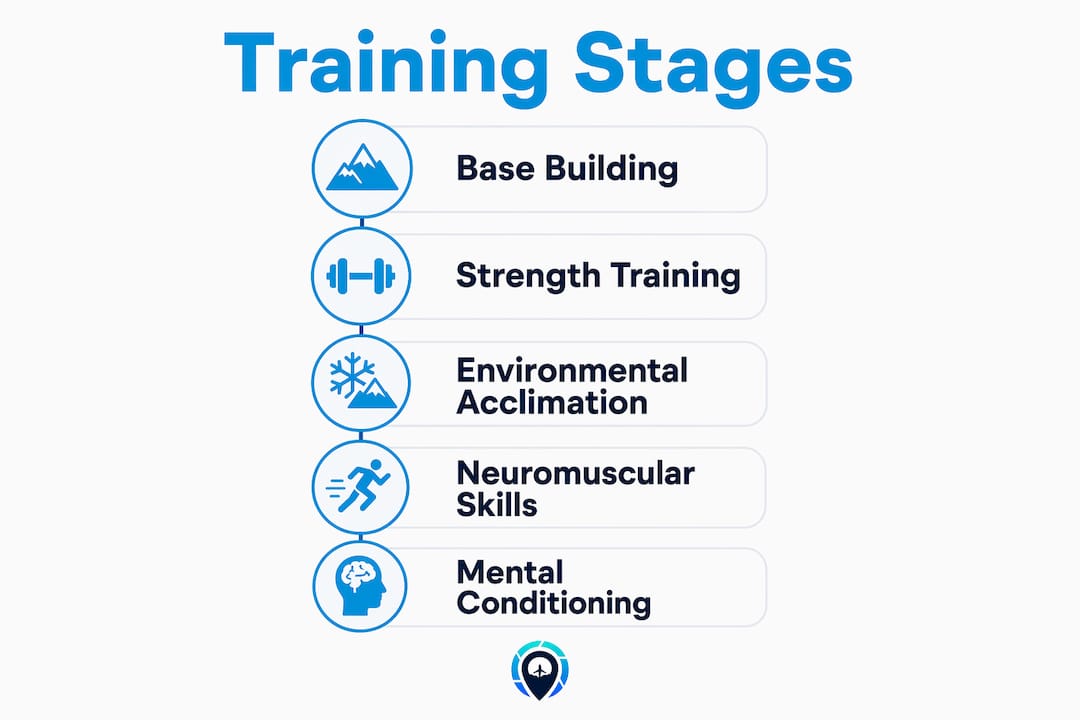
Audit your trip demands first. Map the daily elevation gain, distance, load weight, and environmental conditions. A Kilimanjaro climb has completely different demands than a coastal kayaking trip. Knowing your specific stressors lets you train with purpose.
-
Build your aerobic base early. Structured preparation programs typically last 6–10 weeks, ranging from 6–8 weeks for general backcountry trips up to 10 weeks for alpine trekking. Start with your aerobic base before adding intensity.
-
Add interval training in weeks 4–6. Once your base is solid, introduce hill repeats, stair climbs with a pack, or rowing intervals. These sessions teach your cardiovascular system to handle surges in effort, which happen constantly on real terrain.
-
Incorporate strength conditioning twice per week. Focus on compound movements that mirror trail demands: lunges, step-ups, Romanian deadlifts, and single-leg work. Avoid training to failure. You need to recover between sessions.
-
Simulate your environment. If you’re heading somewhere hot, train in heat. If you’re going to altitude, include hypoxic breathing exercises. Environmental specificity is what separates prepared adventurers from people who struggle on day two.
-
Taper in the final week. Reduce volume by 40–50% in the last 7 days before your trip. Your body needs time to consolidate the adaptations you’ve built.
Pro Tip: Don’t skip the “boring” base work in weeks 1–3. Adventurers who rush straight to high-intensity training often arrive at the trailhead with overuse injuries. Patience in the early weeks pays off on the mountain.
How does environmental conditioning enhance adventure readiness?
Your body treats environmental stressors as training signals, not just discomforts to endure. Environmental stressors should be conditioned as systems, emphasizing metabolic acclimatization rather than simple tolerance. That shift in mindset changes how you prepare.
Key environmental adaptations worth training deliberately:
- Cold adaptation: Graded cold exposure activates brown adipose tissue, which generates heat metabolically. Regular cold showers, outdoor winter training, and cold water immersion all trigger this response over time.
- Heat acclimatization: Training in heat increases plasma volume and improves sweat efficiency. Even 10–14 days of heat exposure before a desert or tropical trip produces measurable cardiovascular benefits.
- Vestibular training: Motion sickness on boats, planes, and winding mountain roads is a vestibular system issue. Balance board training, gaze stabilization drills, and gradual exposure to motion environments reduce symptoms significantly.
- Layering as a conditioning system: Learning to manage your thermal layers during exercise is a skill. Practicing it in training prevents dangerous overheating and chilling on actual expeditions.
“Graded exposure to heat and cold trains core systems, including metabolic and vascular adaptations, improving environmental resilience. Activation of brown fat and increased plasma volume are key physiological adaptations that separate prepared adventurers from those who simply hope to acclimatize on arrival.”
The practical takeaway here is that environmental conditioning requires lead time. You can’t acclimatize to heat in two days. Build these exposures into your 6–10 week program from the start, not as an afterthought in the final week.
What neurocognitive and functional fitness elements support adventure success?
Physical fitness alone doesn’t keep you safe in complex outdoor environments. Mental training integrated with physical conditioning reduces decision fatigue and improves safety in demanding adventure settings. That connection between cognitive load and physical performance is one of the most underappreciated factors in adventure preparation.
When you’re fatigued, your decision-making degrades. Route-finding errors, gear mistakes, and risk miscalculations all increase when your brain is running on fumes. Training your body to function under metabolic stress also trains your mind to stay sharp longer.
Multi-sport adventure racing develops metabolic efficiency and neuromuscular recalibration that single-sport training simply can’t replicate. The constant movement transitions between running, cycling, paddling, and climbing force your nervous system to adapt rapidly. That adaptability transfers directly to unstructured outdoor environments.
| Training Method | Primary Benefit | Adventure Application |
|---|---|---|
| Adventure racing circuits | Neuromuscular recalibration | Multi-terrain navigation and transitions |
| Loaded hiking with navigation | Cognitive load under fatigue | Route-finding on long days |
| Multi-sport interval sessions | Metabolic efficiency | Sustained effort across varied terrain |
| Yoga and balance training | Proprioception and joint stability | Technical footing and pack balance |
Physiological adaptability to multi-mode terrain is uniquely developed through adventure racing styles of training. This isn’t just about fitness. It’s about teaching your nervous system to recalibrate quickly when the ground changes beneath your feet.
Pro Tip: Add one “chaos session” per week to your training. This means combining two or three different movement types back to back, like a 20-minute run followed immediately by a 15-minute paddle or bike ride. Your body learns to shift gears, and your brain stays engaged under fatigue.
Key Takeaways
Physical conditioning for adventure success requires targeted endurance, strength, environmental adaptation, and cognitive resilience built through structured, specific training over 6–10 weeks.
| Point | Details |
|---|---|
| Start 6–10 weeks out | Structured programs build aerobic and strength adaptations that can’t be rushed. |
| Train for your specific terrain | Audit your trip demands and match your conditioning to actual environmental stressors. |
| Don’t skip eccentric loading | Downhill tolerance and joint durability prevent the most common adventure injuries. |
| Condition your environment response | Heat, cold, and motion adaptation require deliberate graded exposure, not last-minute hope. |
| Train your brain alongside your body | Cognitive resilience under fatigue is a trainable skill that keeps you safe in the field. |
Durability over intensity: what I’ve actually learned
Most adventure training advice focuses on intensity. Go harder, go longer, push more. I’ve found that approach leads to one place: arriving at the trailhead already worn down.
The concept I keep coming back to is durability. Durability-focused training targets muscular endurance under prolonged fatigue, not just peak intensity or maximal strength. That distinction matters enormously on a 12-day trek where day 8 is harder than day 1 simply because your reserves are depleted.
Recovery is an active training component that drives physiological adaptation. Sleep, protein intake, and scheduled easy days aren’t luxuries. They’re where your body actually gets stronger. I’ve watched people train brilliantly for 8 weeks and then sabotage themselves by skipping rest days in the final stretch.
The mental side is just as real. Training through monotony, through sessions where nothing feels exciting, builds the psychological grit you need when the weather turns bad on day 6 and you still have 4 days to go. Adventure success hinges more on pacing discipline and decision-making under stress than raw power. That’s the thing most people don’t want to hear, but it’s true every single time.
— Justin Frazier
Ready to put your conditioning to work on a real adventure?
Physical preparation is only half the equation. Knowing where to go, what to expect, and how to plan a trip that matches your fitness level makes the whole experience click. Traveling Portrait’s adventure travel essentials guide covers the foundational knowledge every prepared explorer needs before stepping into the field. If you want to pair your conditioning with smart trip planning, the adventure travel planning guide walks through how thorough preparation translates directly into better, safer, and more rewarding experiences. Your fitness work deserves a trip that’s worth every training session.
FAQ
What is physical conditioning in adventure travel?
Physical conditioning in adventure travel is the process of building endurance, strength, and environmental adaptability specific to the demands of outdoor activities. It goes beyond general fitness to address the exact stressors of your planned trip.
How long should I train before an adventure trip?
Structured preparation programs last 6–10 weeks, with 6–8 weeks covering general backcountry trips and up to 10 weeks for alpine trekking. Starting earlier gives your tendons and joints time to adapt alongside your cardiovascular system.
Why is eccentric training important for adventurers?
Eccentric loading builds downhill tolerance and joint durability, which are the adaptations most commonly missed by beginners. Without it, descents cause disproportionate muscle damage and increase injury risk significantly.
How does environmental conditioning work?
Graded exposure to heat and cold triggers metabolic and vascular adaptations, including brown fat activation and increased plasma volume. These changes improve your body’s ability to regulate temperature and sustain performance in challenging conditions.
Does mental fitness matter as much as physical fitness for adventures?
Mental training integrated with physical conditioning reduces decision fatigue and improves safety in complex environments. Cognitive resilience under physical stress is a trainable quality, not a fixed personality trait.
Recommended
Other Posts You Might Like