

Build a Travel Photography Portfolio That Gets Noticed
A travel photography portfolio is a curated collection of your best images that tells your unique travel story and demonstrates your photographic skill to editors, clients, and buyers. The industry term for this kind of presentation is a “photography portfolio,” and it functions as your visual resume in the commercial photography world. To build a travel photography portfolio that actually opens doors, you need intentional curation, smart organization, and a presentation that speaks directly to whoever is hiring. Industry guidance recommends 30–50 tightly curated images for general pitch sites, with 200–300 exceptional images for commercial archives. That range matters because it tells you exactly how selective you need to be.
What images should you include in your travel photography portfolio?
The most common portfolio mistake is trying to show everything. Clients value a visual resume that communicates intentional curation and consistent storytelling, not a highlight reel of every country you’ve visited. Quality and thematic consistency outweigh quantity every single time.
Start by identifying the travel photography genres you shoot best. Strong portfolios typically cover a mix of:
- Landscape and environment: Wide shots that establish a sense of place
- Culture and people: Portraits and street scenes that show human connection
- Wildlife: Action and behavior shots from natural settings
- Architecture: Structural details and urban environments
- Food and markets: Close-up, atmospheric shots that evoke sensory experience
- Events and festivals: Dynamic, energetic images with strong composition
You don’t need to cover all six. Picking two or three and doing them exceptionally well is far more effective than spreading yourself thin across every genre. Check out Traveling Portrait’s guide to travel photography styles to figure out where your strengths actually lie.
One thing most photographers overlook: self-directed personal projects produce some of the most compelling portfolio work because of the creative control they give you. Clients don’t distinguish between paid and personal projects if the quality and professionalism are consistent. That road trip through Patagonia you funded yourself? It belongs in your portfolio if the images are strong.

Organize your selections by destination or theme, never chronologically. Buyers search for specific geographic or subject expertise, not your career timeline. A client looking for Iceland winter landscapes doesn’t care that you shot them three years ago.
Pro Tip: Pull your 100 favorite images, then cut that list in half. The images that survive two rounds of editing are the ones that belong in your portfolio.
How to organize and present your portfolio online for maximum impact?
Your online portfolio is a brand platform, not just an image gallery. Beyond the images themselves, presentation helps clients visualize working with you. That means your site needs a professional bio, clear contact information, and a plain-language explanation of the services you offer.
Here’s a practical structure that works for travel photographers:
- Homepage: A strong hero image or short gallery loop with your name and a one-line description of what you shoot
- Portfolio galleries: Organized by continent, destination, or subject (not by date)
- About page: A short bio that explains your background, style, and the types of clients you work with
- Services page: Clear descriptions of what you offer, whether that’s licensing, editorial assignments, prints, or workshops
- Contact page: A simple form plus your direct email address
Mobile friendliness is non-negotiable. A large percentage of editors and art directors browse portfolios on their phones during commutes or between meetings. If your gallery doesn’t load cleanly on a small screen, you’ve already lost them.
Protect your work while keeping it discoverable. Watermarked low-resolution previews deter theft while still letting clients evaluate your style. Pair that with embedded IPTC metadata and geotags on every image file. This is an insider technique that boosts organic discovery by editors searching for specific locations or subjects.
Pro Tip: Name your image files descriptively before uploading. “iceland-lupine-field-sunset.jpg” ranks in image search. “IMG_4823.jpg” does not.
SEO also applies to your portfolio pages. Use descriptive page titles, alt text on every image, and location-specific keywords in your gallery descriptions. Social proof matters too. Add testimonials from past clients, press mentions, or publication credits near your contact form. These details convert browsers into inquiries.
| Presentation element | Why it matters |
|---|---|
| Professional bio | Helps clients assess fit before reaching out |
| IPTC metadata and geotags | Boosts organic discovery by editors and search engines |
| Watermarked low-res previews | Protects work while enabling style evaluation |
| Mobile-friendly layout | Reaches editors browsing on phones and tablets |
| Contact form with clear CTA | Reduces friction for potential clients to hire you |
What tools and platforms support building an effective travel photography portfolio?
Platform choice shapes how your portfolio looks, loads, and sells. Squarespace, SmugMug, Format, and Adobe Portfolio each offer custom domains, e-commerce integration, and photography-specific templates. The right pick depends on what you need most.
Squarespace suits photographers who want design control and a clean, modern look without coding. SmugMug is built specifically for photographers and supports print sales, client galleries, and licensing directly from your portfolio. Format sits between the two, offering strong portfolio templates with e-commerce options at a mid-range price. Adobe Portfolio is free with a Creative Cloud subscription, which makes it a solid starting point if you’re already paying for Lightroom or Photoshop.
Community platforms like Behance and Flickr offer exposure to a large audience, but they give you limited control over presentation and branding. They work well as supplementary channels, not as your primary portfolio home. Your main portfolio should live on a domain you own.
Fast loading times are critical. A slow gallery kills client interest before a single image loads. Compress your images before uploading and use a platform with a content delivery network built in. Easy updating matters just as much. If adding new work feels like a chore, you’ll put it off, and an outdated portfolio is worse than no portfolio at all.
For photographers who want to document travel experiences and sell prints or licenses directly, SmugMug’s built-in e-commerce tools remove the need for a separate storefront. For those focused on editorial pitching, Format’s clean presentation and easy PDF portfolio export are genuinely useful.
How to maintain and grow your travel photography portfolio over time?
A portfolio is never finished. The photographers who land consistent work treat their portfolio as a living document, not a one-time project.
Here’s what ongoing portfolio maintenance looks like in practice:
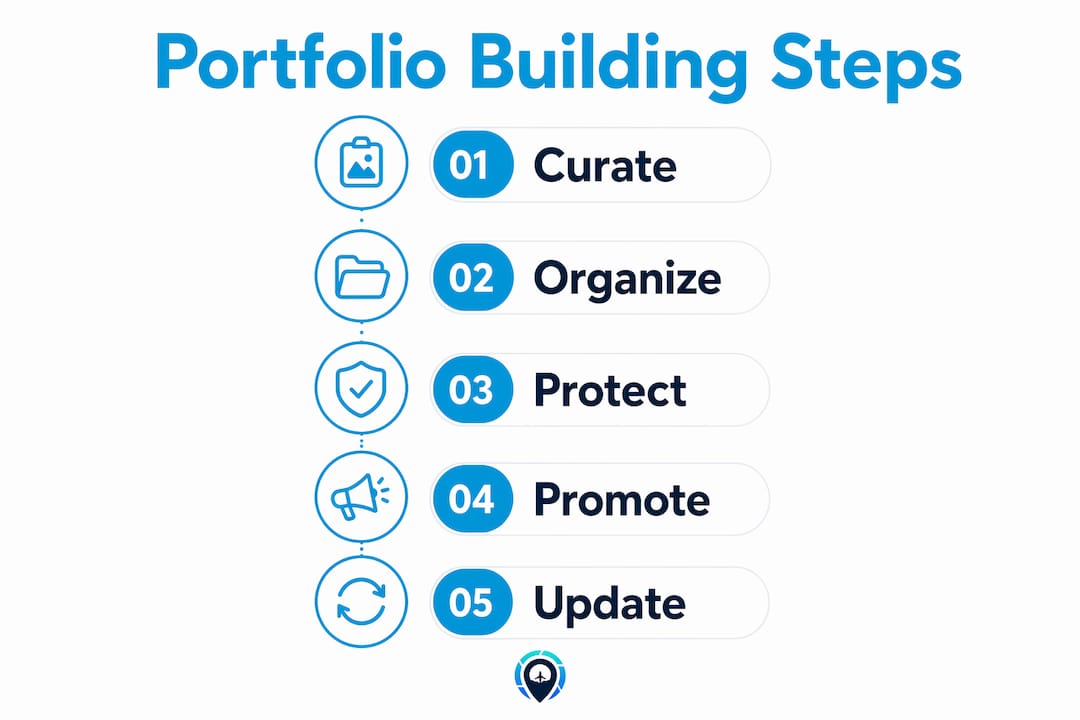
- Quarterly image audits: Remove your weakest images every few months. Your portfolio should only ever get stronger, not longer.
- New work additions: Add fresh images after every significant trip or project. Clients notice when a portfolio hasn’t been updated in over a year.
- Analytics review: Most portfolio platforms show which galleries get the most views. Use that data to understand what buyers are actually looking for.
- Email list building: Integrating a lead magnet like free wallpapers or a destination guide into your portfolio site builds a direct channel to editors and buyers. Email promotions convert at 3–5%, which means a list of 500 engaged contacts generates real inquiries over time.
Editorial work builds credibility first, and commercial projects follow with higher budgets. That’s the standard career arc for travel photographers. Pitch travel magazines, online publications, and tourism boards with your editorial work. Use those credits to attract commercial clients who pay more but require a proven track record.
Combine your portfolio with a blog, active social media presence, and occasional workshops to stay visible between assignments. Traveling Portrait’s travel photography blog is a good example of how consistent content creation keeps an audience engaged and builds long-term authority in the space.
Pro Tip: Set a calendar reminder every 90 days to review your portfolio. Treat it like a business task, not a creative one. The discipline of regular updates separates working photographers from aspiring ones.
Pricing and licensing are part of portfolio growth too. Set clear rates for editorial use, commercial licensing, and print sales. Underpricing signals inexperience to buyers just as much as a weak portfolio does.
Key Takeaways
A strong travel photography portfolio combines tight curation, strategic organization, and consistent marketing to attract clients and editors over the long term.
| Point | Details |
|---|---|
| Curate ruthlessly | Limit your pitch portfolio to 30–50 images that reflect a coherent style and story. |
| Organize by theme or destination | Buyers search by location and subject, not by the date you shot the images. |
| Build a brand platform, not just a gallery | Include a bio, services page, contact form, and social proof alongside your images. |
| Protect and optimize every image | Use watermarked low-res previews, IPTC metadata, and descriptive filenames for SEO and protection. |
| Maintain and market consistently | Quarterly audits, email list building, and editorial pitching keep your portfolio working for you. |
What I’ve learned from building a portfolio that actually gets hired
Most photographers spend months perfecting their images and about 20 minutes thinking about how to present them. That’s backwards. The photographers I’ve seen land consistent editorial and commercial work treat their portfolio like a product, not a passion project. They think about who’s looking at it, what those people need to see, and how quickly they can find it.
The advice I’d push back on hardest is the idea that you need to travel more before your portfolio is “ready.” You probably already have enough strong images. The real work is editing down to the ones that tell a clear, consistent story. I’ve seen portfolios with 12 images outperform ones with 200 because the 12 were chosen with a specific client in mind.
Personal projects matter more than most photographers realize. The Iceland photo tour content on Traveling Portrait is a perfect example. Those images weren’t all commissioned, but they’re cohesive, location-specific, and visually strong. That’s exactly what buyers want to see. They’re not hiring your resume. They’re hiring your eye.
The other thing I’d say: don’t wait until your website is perfect to start pitching. A clean, simple portfolio on a platform you can update easily beats a beautiful site you’re still building six months from now. Get your best 30 images online, write a real bio, and start sending it to editors. The portfolio improves as you work, not before.
— Justin Frazier
Traveling Portrait can help you take your portfolio further
Building a portfolio is one thing. Getting it in front of the right people is another. Traveling Portrait offers hands-on travel photography workshops designed to help aspiring photographers sharpen their skills, develop a consistent visual style, and create images that hold up in a professional portfolio.
Whether you’re just starting to put your first gallery together or you’re ready to pitch editorial clients, the workshops cover real-world techniques from photographers who’ve done it. You’ll also find destination-specific inspiration across Traveling Portrait’s destinations galleries, which show exactly how thematic and location-based organization works in practice. If you’re serious about turning your travel photography into something more than a hobby, this is where to start.
FAQ
How many images should a travel photography portfolio have?
Industry guidance recommends 30–50 curated images for general pitch portfolios and 200–300 for commercial archives. Quality and consistency matter far more than volume.
Should I organize my portfolio by date or by destination?
Organize by destination or theme, not by date. Buyers search for specific geographic or subject expertise, so grouping images by location or subject makes it easier for them to find what they need.
Can I include personal projects in my travel photography portfolio?
Yes. Clients don’t distinguish between paid and personal projects if the quality and professionalism are consistent. Strong self-directed work often makes the most compelling portfolio content.
How do I protect my images on my portfolio website?
Use watermarked low-resolution previews and embed IPTC metadata and geotags in every image file. This approach deters theft while enabling organic discovery by editors searching for specific locations.
How often should I update my travel photography portfolio?
Review and update your portfolio at least every 90 days. Remove weaker images, add new work from recent trips, and check your analytics to see which galleries attract the most attention from potential clients.
Recommended
Other Posts You Might Like