

The Role of Travel Journaling in Meaningful Trips
Travel journaling is the purposeful practice of recording your thoughts, emotions, and sensory experiences during travel, creating a personal narrative that deepens your trip far beyond photos alone. The role of travel journaling goes well past nostalgia. It builds memory, sharpens mindfulness, and documents who you are becoming as you move through the world. Psychotherapists and travel experts alike point to journaling as one of the most effective tools for emotional processing on the road. Whether you’re planning your first solo adventure or your fiftieth international trip, a travel journal gives your experiences a place to live long after you’ve returned home.
What are the benefits of travel journaling for memory and well-being?
Travel journaling delivers real, measurable benefits for your brain and your emotional health. 68% of travel enthusiasts report that tactile journaling produces deeper memory retention and emotional processing than digital photo sharing alone. That’s a striking gap, and it makes sense when you think about it. Writing forces your brain to reconstruct an experience actively, while scrolling through photos is passive.
Psychotherapists observe that five minutes of daily writing can significantly reduce travel-related stress. Writing gives chaotic emotions a structured place to land, which is especially useful when you’re jet-lagged, culture-shocked, or just overwhelmed by a new city. That grounding effect is something no Instagram grid can replicate.
“Journaling invites travelers to slow down and engage intentionally with their internal experience, acting as a form of mindfulness. The value lies in who you become by doing it, not in aesthetic or ‘Instagrammable’ presentation.”
The benefits of travel journaling extend beyond the trip itself. Entries you write in real time become primary sources for your own life story. Here’s what consistent journaling actually does for you:
- Deepens memory retention by forcing active reconstruction of experiences rather than passive review
- Reduces travel stress by giving emotions a structured outlet, as psychotherapists confirm
- Builds emotional awareness by helping you name and process feelings in real time
- Creates a personal archive that photos and social media feeds cannot replicate
- Sharpens cultural observation by encouraging you to notice details you’d otherwise miss
The importance of travel journaling also shows up in how it changes your relationship with the present moment. When you know you’ll write about something later, you pay closer attention to it now. That shift in attention is the core of mindfulness, and it costs you nothing but a few minutes and a pen.
How do effective travel journaling methods work?
The most common reason travelers quit journaling is overcommitment. 90% of travelers fail to keep a journal beyond three days when they attempt full nightly recaps. That number should change how you approach the whole thing. Sustainability beats ambition every time.

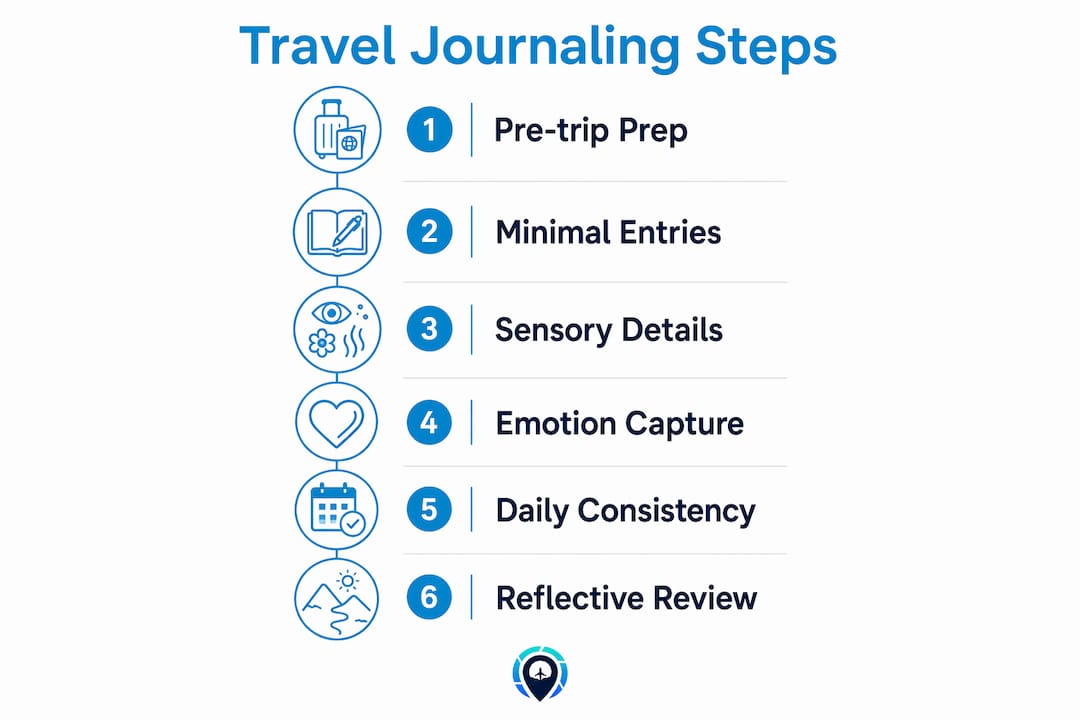
The fix is what experts call the minimal viable entry : one sensory detail, one emotion, and one forgettable fact per day. That’s it. The forgettable fact is the secret weapon here. It’s the kind of thing you’d never photograph but would absolutely forget, like the name of the street vendor who made your coffee, or the exact shade of light at 6:00 AM in Lisbon.
Physical vs. digital journaling
Both formats work. The right choice depends on your travel style and what you’ll actually stick with.
| Format | Strengths | Watch out for |
|---|---|---|
| Physical notebook | Tactile engagement, no battery needed, ephemera-friendly | Can get wet or damaged; harder to search later |
| Digital app or notes | Searchable, backed up, easy to type fast | Screen fatigue; easier to skip when distracted |
| Voice memo | Captures raw emotion instantly | Requires transcription; less reflective |
If you go physical, hardcover journals with sewn bindings outperform glued spines under real travel conditions. A journal that falls apart in your bag is a journal you stop using. Tuck in ticket stubs, pressed flowers, or a torn corner of a map. Physical ephemera creates sensory memory anchors that pull you back into a moment years later.
Pro Tip: Start your journal before you leave home. Write down your pre-departure fears, expectations, and what you’re hoping to feel. Experts recommend this because it creates a baseline for reflection that makes your post-trip entries far more revealing.
Here’s a simple system that works for most travelers:
- Morning (2 minutes): Write one thing you’re curious or nervous about for the day ahead.
- Midday (1 minute): Jot a single sensory detail while it’s fresh, a smell, a sound, a texture.
- Evening (2 minutes): Record one emotion and one forgettable fact from the day.
That’s five minutes total. 3–5 minutes of daily journaling is the sweet spot for long-term consistency. You can always write more, but you never have to.
Why is travel journaling transformative for personal growth?
Travel journaling functions as what you might call an emotional laboratory. It’s where you test your assumptions about yourself against the reality of new places and unfamiliar situations. The act of converting raw experience into narrative is where genuine personal growth happens. You’re not just recording what happened. You’re making sense of it.
This is where travel reflections through journaling get genuinely interesting. Most travelers notice patterns in their entries that they’d never catch in real time. You might realize you feel most alive near water, or that you consistently feel anxious on the first day of any new destination. Those patterns are data about who you are.
Here’s what journaling actually surfaces during travel:
- Value clarification: What you write about most reveals what matters to you most.
- Perspective shifts: Entries from day one versus day seven of the same trip often read like two different people wrote them.
- Cultural awareness: Journaling enhances attention to cultural details and emotional nuances that faster-paced documentation misses entirely.
- Challenge processing: Writing through culture shock or a difficult travel day converts stress into understanding.
- Awe documentation: Capturing moments of genuine wonder preserves them in a way that a photo simply cannot.
The key is keeping the process nonjudgmental. You’re not writing for an audience. You’re writing for future you, who will want to know exactly what it felt like to stand in that market in Marrakech at noon, not just what it looked like.
Pro Tip: If you feel stuck, write about what annoyed you. Frustration is honest, and honest entries always contain the most useful insights. The most meaningful journal entries come from raw, unfiltered moments, not polished ones.
You can also explore how travel diaries support emotional well-being during trips, which pairs naturally with the personal growth angle of consistent journaling.
What are common travel journaling pitfalls and how do you avoid them?
Perfectionism kills more travel journals than laziness does. The moment you decide your entry needs to be beautifully written, you’ve made it a chore. Authentic, raw entries produce the most meaningful insights. Curated, polished writing produces something closer to a press release about your own life.
The other big trap is waiting until you get home. Memory degrades fast, and the emotional texture of a moment fades within hours. Real-time capture, even a few messy words on your phone, beats a beautifully written recap written two weeks later.
Avoid these common mistakes:
- Skipping days and then trying to catch up: Catch-up entries feel like homework. Write something tiny every day instead.
- Treating your journal like a travel itinerary: Lists of places visited are not journaling. Feelings, observations, and questions are.
- Choosing a journal that’s too precious to use: A beautiful leather journal you’re afraid to mess up stays blank. Pick something you’ll actually write in.
- Writing for an imagined reader: The moment you start performing, you lose the honest voice that makes entries worth reading later.
- Using prompts as a crutch forever: Prompts are great for getting started, but the goal is to eventually write freely without them.
Pro Tip: If you genuinely can’t write a sentence, send yourself a voice memo or a text message describing the moment. That informal, texting-style capture is a legitimate journaling technique. You can document your travel journey in any format that keeps you consistent.
The gear matters less than the habit. A $2 notebook and a working pen beat an expensive journal system you never open.
Key Takeaways
Travel journaling builds deeper memory, reduces stress, and documents personal growth in ways that photos and social media cannot replicate.
| Point | Details |
|---|---|
| Memory retention | Tactile journaling produces deeper memory recall than digital photo sharing alone. |
| Sustainable habit | Limit entries to 3–5 minutes daily to avoid burnout and maintain consistency long-term. |
| Minimal viable entry | Capture one sensory detail, one emotion, and one forgettable fact per day as your baseline. |
| Personal growth | Patterns in your entries reveal values, perspective shifts, and emotional responses you’d otherwise miss. |
| Authenticity over aesthetics | Raw, unfiltered entries produce more meaningful insights than polished or curated writing. |
Why I think most travelers are journaling wrong
I’ll be honest. The first time I tried keeping a travel journal, I bought a gorgeous hardcover notebook, wrote three perfect pages in Reykjavik, and then didn’t open it again for the rest of the trip. I was so focused on writing well that I stopped writing at all.
What changed everything for me was giving myself permission to write badly. A single ugly sentence written in the moment beats a beautiful paragraph written from memory a week later. The emotional truth of a place lives in the messy, immediate version, not the polished one.
The other thing I’ve noticed is that journaling changes how I travel, not just how I remember it. When I know I’ll write about a place, I look harder. I ask more questions. I stay a little longer at the market stall or the viewpoint. That shift in attention is the real gift of keeping a journal. It’s not about the pages you fill. It’s about the traveler you become while filling them.
If you’re waiting until you feel “ready” to start, don’t. Grab whatever you have nearby and write one sentence about where you are right now. That’s the whole practice, right there.
— Justin Frazier
Traveling Portrait and the art of documenting adventure
Traveling Portrait is built on the belief that the best travel experiences are the ones you actually remember, in full color, with all the feeling intact. That’s why we cover everything from adventure travel fundamentals to the practical gear and skills that make documentation feel natural rather than forced.
If you want to go deeper on travel documentation, our photography workshop pairs beautifully with a journaling practice. Visual storytelling and written storytelling reinforce each other in ways that make both stronger. Traveling Portrait’s guides, stories, and destination resources are all built to help you show up more fully to every trip you take.
FAQ
What is the role of travel journaling?
Travel journaling is the practice of recording thoughts, emotions, and sensory details during travel to deepen memory, process experiences, and document personal growth. It functions as both a mindfulness tool and a personal archive that photos alone cannot create.
How do I start a travel journal if I’ve never done it before?
Start before your trip by writing your pre-departure expectations, then commit to just 3–5 minutes of daily entries using the minimal viable entry method: one sensory detail, one emotion, and one forgettable fact.
Is a physical journal better than a digital one for travel?
Physical journals with hardcover, sewn bindings offer durability and tactile engagement that supports deeper memory retention. Digital formats work well for travelers who prioritize speed and searchability. The best format is whichever one you’ll actually use consistently.
How does travel journaling support mental health?
Psychotherapists confirm that writing for as little as five minutes daily provides a structured space to offload chaotic emotions, which measurably reduces travel-related stress and increases presence during the trip.
What should I write about in a travel journal?
Write about sensory details, emotional reactions, cultural observations, and the small forgettable facts that define a place. Avoid turning entries into itinerary lists. The most meaningful content comes from honest, unfiltered reflection rather than curated summaries.
Recommended
Other Posts You Might Like