
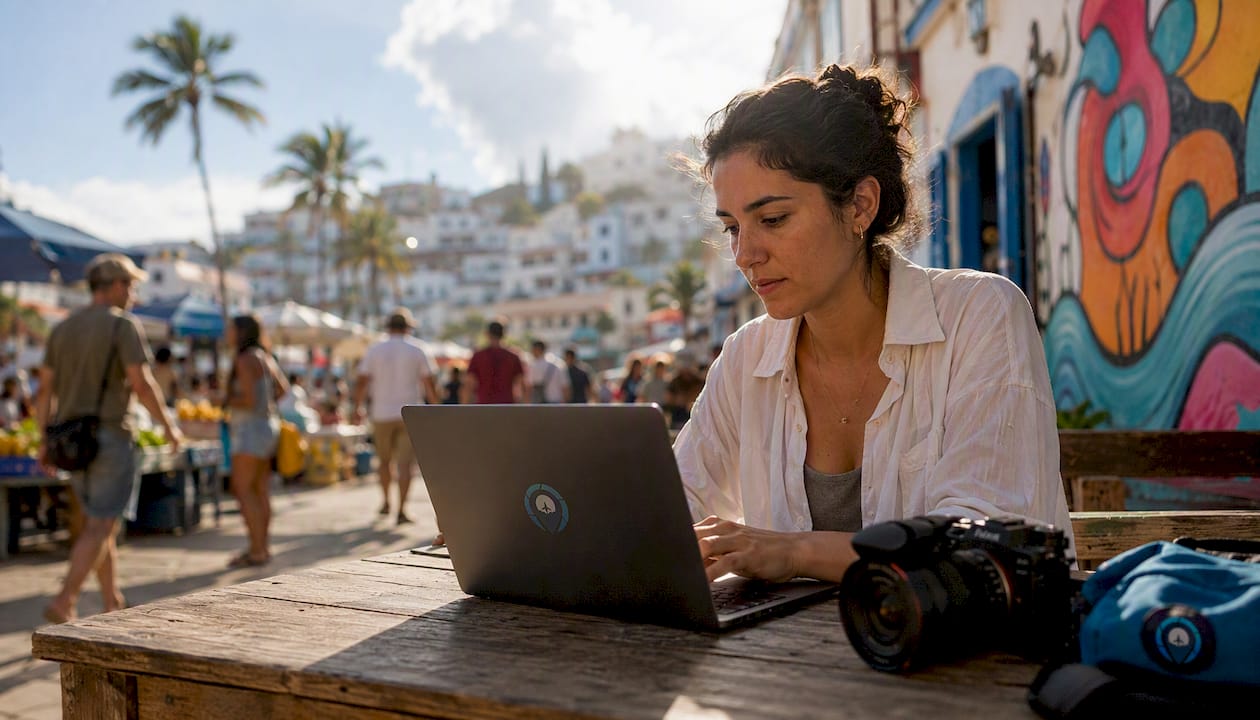
Build a Freelance Career While Traveling: Photography Guide
Yes, you can absolutely build a freelance travel photography career while you’re on the road — and you don’t need to wait until you’re “ready.” The three things you need right now: a client-focused niche, a diversified income stack, and the basic business setup (website, rates, contracts). Traveling Portrait has seen photographers go from zero paid gigs to repeat hospitality clients within a few months by following exactly this playbook.
Your first 24–72 hours:
- Write one sentence that defines your niche and ideal client (e.g., “I photograph boutique hotels and retreats for their social and web content”)
- Publish one portfolio gallery that looks like commissioned work, not vacation snapshots
- Draft a one-paragraph outreach pitch you can personalize and send today
The realistic first year involves landing initial gigs and building your audience early on, adding licensing and digital products partway through, and working towards stable income by stacking streams over time. Practitioners confirm that traveling is not the business — photography is the business, and content like destination guides and workshops convert free readers into paying clients.
Table of Contents
- What does your first 30 days on the road look like?
- How do you pick a niche that actually pays?
- What income streams work for traveling photographers?
- What business setup do U.S. traveling photographers actually need?
- How do you find and win clients while you’re on the move?
- What gear and workflow keep you productive on the road?
- How do you build an audience and make your income scale?
- Key Takeaways
- What the road actually teaches you about this business
- Ready to fast-track your travel photography career?
- Useful sources and references
What does your first 30 days on the road look like?
Getting set up fast matters more than getting set up perfectly. Here’s what to tackle in your first month:
Website essentials:
- Niche statement on your homepage (one sentence, above the fold)
- 2–4 tight galleries that resemble paid work — see Traveling Portrait’s portfolio-building guide for gallery structure ideas
- A short services page with clear deliverables and a contact form
Admin essentials:
- Business email (not a personal Gmail)
- Payment method tested internationally (Wise or PayPal both work; test before you fly)
- Simple invoice template with your payment terms written in
- Cloud backup or portable SSD confirmed and working
Legal/finance basics:
- A short contract template for every paid shoot — even a one-page agreement counts
- Bookkeeping spreadsheet or app set up from day one
- Note the IRS 1099-NEC threshold ($600) and quarterly estimated tax rules so you’re not surprised later
Logistics:
- Two memory cards minimum, one portable SSD, spare battery
- Travel-friendly gear checklist packed and confirmed before departure
Pro Tip: Shoot one unpaid local brief — a café, a guesthouse, a market stall — and deliver it exactly as you would a paid job: edited selects, organized folders, a short usage note. That gallery becomes your commissioning-style proof of work.
How do you pick a niche that actually pays?
The photographers who get hired fastest are the ones who use focused, personalized outreach to a specific client type rather than waiting to be discovered. Start with commercial categories that have real budgets and repeat demand:
- Boutique hotels and guesthouses — need room shots, lifestyle content, and social assets on a rolling basis
- Tour operators and guides — need action and destination imagery for their booking pages
- Retreats and wellness workshops — need day-of coverage and promotional stills
- Destination restaurants — need food and hospitality photography for menus, social, and PR
- Editorial outlets — need 48-hour city guides and destination features
Validate a niche quickly: does the client already have professional imagery on their website? That means they have a budget. Can you reach the decision-maker directly (owner, marketing manager)? That means the sales cycle is short.
Three sample deliverable packages:
- Boutique guesthouse shoot: 3 room setups, 5 lifestyle shots, 10 social-ready edits, delivered within 48 hours
- 48-hour city guide: 20 selects covering food, streets, and landmarks, with captions, licensed for editorial use
- Retreat day-of coverage: 4 hours on location, 30 edited selects, social-ready crops included
Pro Tip: Label your portfolio galleries by client type (“Hotels & Accommodation,” “Editorial,” “Retreats”) rather than by destination. Clients hire based on what you’ve done for someone like them — not where you’ve been.
What income streams work for traveling photographers?
Stacking multiple income lines is the standard approach among working travel photographers — no single stream is reliable enough on its own.
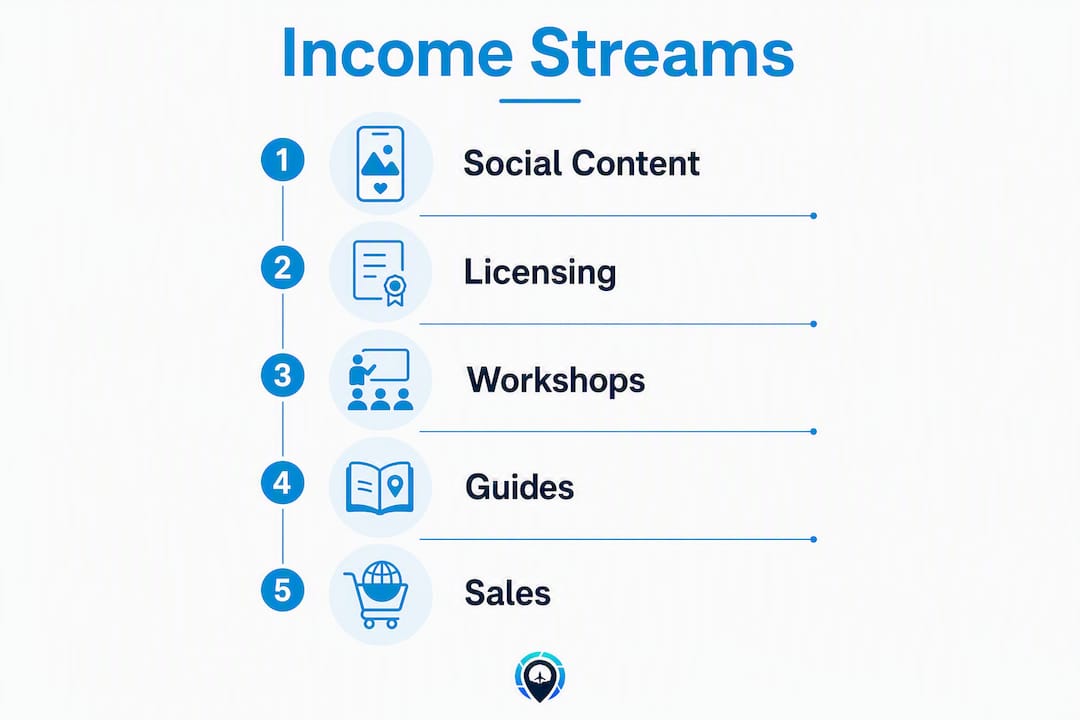
Pricing by deliverable beats hourly rates for most travel photographers. Usage terms shift the number significantly: a single-use social license costs less than a multi-territory web license, which costs less than exclusivity. Always define territory, duration, and exclusivity in your quote.
Pro Tip: Calculate your minimum viable day rate by adding equipment depreciation, travel costs, admin time, and a 25–30% self-employment tax buffer. That number is your floor — never quote below it.
What business setup do U.S. traveling photographers actually need?
You don’t need a complicated structure to start, but you do need the basics in place before you take a paid job.
Entity and insurance:
- Sole proprietor is the simplest start; an LLC adds asset protection and looks more professional to clients. LLC filing fees typically vary by state and range from $50 to $500.
- Carry general liability insurance and consider equipment insurance before you travel
Contractor status: The Department of Labor’s FLSA guidance uses business-like initiative as a key factor in independent-contractor classification. That means: a dedicated website, your own equipment, negotiated rates, and control over how you complete the work. Keep all of those visible.
Tax basics:
- Clients who pay you $600+ must issue a 1099-NEC; you owe self-employment tax on that income
- If you expect to owe $1,000+ in taxes for the year, make quarterly estimated payments to avoid penalties
Essential contract clauses checklist:
- Scope of work and deliverables
- Usage/licensing terms (territory, duration, exclusivity)
- Payment schedule and late-payment terms
- Cancellation and reschedule policy
- Indemnity and insurance confirmation
Pro Tip: Always send a short written agreement, even for a $200 shoot. It protects you and signals professionalism — two things clients remember when they refer you to someone else.
How do you find and win clients while you’re on the move?
Waiting for clients to find you is the most common mistake early-career travel photographers make. Here’s a repeatable outreach sequence:
- Research — identify 5–10 local businesses in your destination with professional-looking websites but mediocre imagery
- Craft a tailored pitch — one paragraph, one portfolio link relevant to their category, one specific idea for their business
- Send via email or DM — keep it under 100 words; decision-makers are busy
- Follow up once — 5–7 days later, one sentence referencing your original message
- Close or nurture — if they’re interested, propose a call or a specific shoot date; if not, add them to a follow-up list for next time you’re in the area
Email template (personalize the bracketed fields):
Hi [Name], I’m a travel photographer currently in [City] and I noticed [specific thing about their imagery]. I’d love to put together a [room shoot / social content day / editorial feature] for [Business Name] — here’s a relevant gallery: [link]. Happy to chat this week if the timing works.
On-the-ground tactics:
- Walk in with a tablet showing your portfolio — managers respond faster in person
- Offer a limited-time rate for your current location to close quickly
- Leave a simple booking path: one email address, one link, no friction
Hospitality outreach pairs well with concierge and property manager networks. Property managers who work with concierge services often coordinate multiple vendors — getting in front of that network can generate referrals across several properties at once.
What gear and workflow keep you productive on the road?
You don’t need the newest gear to start earning — a dependable mirrorless or DSLR body, one versatile zoom, and a lightweight wide or prime covers most commercial briefs. Check Traveling Portrait’s travel photography gear guide for specific picks at different price points.
Gear priority list:
- Dependable camera body (used is fine)
- One versatile zoom (24–70mm equivalent)
- One lightweight wide or prime for interiors and landscapes
- Two memory cards, one portable SSD, two spare batteries
| Setup level | Estimated cost | Notes |
|---|---|---|
| Entry-level traveling kit | — | Used body, one zoom, basic SSD |
| Moderate pro kit | — | Newer body, two lenses, insurance, cloud backup |
| Insurance (annual) | $200–$600 | Equipment + liability; varies by coverage |
File workflow: Ingest to SSD immediately after every shoot. Sync to cloud (Google Drive, Backblaze, or Dropbox) whenever you have reliable Wi-Fi. Deliver selects as full-res JPEGs for social clients, TIFFs or high-res JPEGs for editorial and print. Never delete on-card files until you’ve confirmed the SSD copy and cloud sync.
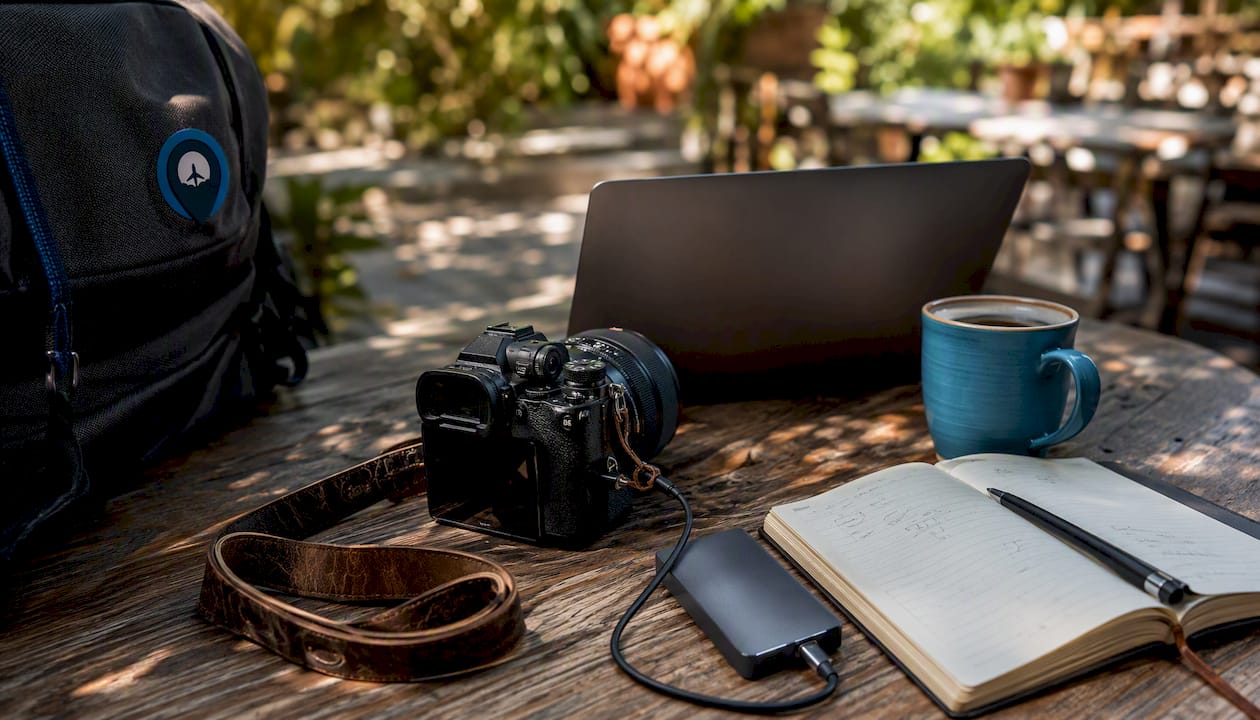
Maintenance on the road: Major travel hubs (Bangkok, Lisbon, Mexico City) have camera repair shops and authorized dealers for common battery and card brands. Pack a lens cloth, silica gel packets, and a small blower — sensor dust is the most common issue in dusty or humid destinations.
How do you build an audience and make your income scale?
Treat travel content as inventory: a destination guide you publish today can drive workshop bookings, print sales, and licensing inquiries for years. The funnel looks like this:
- Blog or destination guide — builds search traffic and demonstrates expertise
Workshops and membership models become reliable only after you’ve built an engaged audience — so start the content funnel early, even before you have a full product lineup. Traveling Portrait’s Iceland Photography Workshop is a real example of this model: destination guides and gear content drive readers to a workshop page, where a small group pays for hands-on instruction in a stunning location.
Pro Tip: Reuse commissioned work in a long-form destination guide or case study. A hotel shoot becomes a “behind the scenes” blog post that ranks in search, seeds your email list, and generates licensing inquiries from other properties in the same region.
For consolidating your portfolio links, workshop signup pages, and social profiles into one shareable link, check out Traveling Portrait’s guide to link-in-bio tools for photographers.
Key Takeaways
Building a sustainable freelance travel photography career requires a client-focused niche, a diversified income stack, and U.S. business basics in place before you take your first paid job.
| Point | Details |
|---|---|
| Niche first, everything else second | Define your ideal client in one sentence and build every gallery around that client type. |
| Stack your income streams | Combine assignments, licensing, digital products, and workshops — no single stream is stable enough alone. |
| Get the legal basics right | Set up a contract template, track 1099-NEC income ($600+ threshold), and make quarterly estimated tax payments if you expect to owe taxes above the IRS-mandated threshold. |
| Start lean on gear | A used mirrorless body and one zoom is enough to land paid hospitality work; invest in backups and insurance before upgrading lenses. |
| Traveling Portrait workshops | Traveling Portrait’s Iceland Photography Workshop combines hands-on shooting with portfolio review and client pitching practice. |
What the road actually teaches you about this business
Here’s something most guides won’t tell you: the photographers who struggle longest are the ones who treat every destination as a fresh start. They rebuild their pitch, their portfolio logic, and their client relationships from scratch in every city. The ones who grow fast treat each location as another data point in a running experiment — same niche, same outreach sequence, same deliverable structure, just a new backdrop.
The other thing worth saying plainly: content and client work are not separate tracks. The destination guide you write after a hotel shoot is the thing that gets you the next hotel shoot, three cities later, from a property manager who found you on Google. That loop — shoot, deliver, document, publish — is the actual business model. The travel is just where it happens.
Workshops accelerate this loop because they force you to articulate what you know. Teaching a small group how to shoot a boutique hotel interior in Iceland is not a distraction from client work — it’s proof of expertise that clients can see, and it generates a gallery of behind-the-scenes content that feeds the funnel for months.
Ready to fast-track your travel photography career?
Traveling Portrait’s travel photography workshops are built for exactly this roadmap. Each workshop combines hands-on shooting in a real destination (including the flagship Iceland Photography Workshop), portfolio review sessions, and live client pitching exercises so you leave with images you can actually send to hospitality clients.
What you get: small-group instruction (so you actually get feedback, not just a lecture), a follow-up resource pack with outreach templates and pricing guidance, and a portfolio gallery from the workshop location ready to use in your next pitch. Browse current workshop dates and destinations, then book your spot or reach out for mentoring options.
Useful sources and references
- IRS / 1099 Freelance Tax Guide for Photographers: 1099-NEC thresholds, quarterly payments, and deductions
- How to Start a Travel Photography Business: LLC filing costs and business planning basics
- Travel Photography Business Guide (DIY Photography): income stacking and content monetization
- How to Make Money as a Travel Photographer (Joris Hermans): workshops and membership models
- Traveling Portrait — Portfolio Guide: commissioning-style gallery advice
- Traveling Portrait — Gear Guide: travel-friendly gear picks
This guide covers general information for U.S.-based freelancers and is not legal, tax, or financial advice. Consult a CPA or attorney for your specific situation, and always verify visa and work-permit rules with the relevant embassy or immigration authority before working in a foreign country — rules vary significantly by destination and nationality.
Recommended
Other Posts You Might Like