

Budget Travel Across Continents: Your 2026 Planning Guide
A six-month multi-continent trip budget depends heavily on destination choices and travel style. A full year of travel budget varies widely, with cheaper options available by focusing on more affordable regions. Those numbers assume backpacker-style travel: hostel dorms, street food, and public buses. The biggest variable isn’t your willpower at the souvenir stall. It’s where you choose to go.
Here’s a quick snapshot of what daily and total costs look like across the most popular regions:
- Southeast Asia (Thailand, Vietnam, Cambodia): backpacker and mid-range daily costs vary by travel style but tend to be affordable
- Latin America (Mexico, Colombia, Guatemala): daily costs depend on travel style and location, with generally moderate expenses
- Eastern Europe / Balkans : daily travel costs vary significantly by country and budget
- Western Europe : tends to be more expensive, with higher daily costs for most travelers
- Japan : daily expenses can be on the higher side, reflecting the country’s cost of living
- Australia : typically among the more expensive destinations with substantial daily costs
- 6-month trip total (60/40 mix) : budget around $9,000 to $10,500, with an extra $1,800 to $2,500 for flights between regions
- 12-month trip total (60/40 mix) : estimated annual cost is typically $17,000 to $20,000, depending on region mix and spending habits
- 12-month trip total (80/20 cheap-heavy) : costs can drop to $11,000 to $13,000 by focusing on lower-cost regions
Flights between regions often add a significant cost outside the daily budget, varying by route and timing. Everything below breaks down exactly how to hit those numbers, and how to push them lower.
Table of Contents
- How travel style and region shape your daily budget
- What actually drives your total travel costs
- Smart budgeting strategies that actually work
- How to plan your multi-continent trip step by step
- How slow travel can cut your costs in half
- How long should you spend on each continent?
- Safety tips every long-term budget traveler needs
- Key Takeaways
How travel style and region shape your daily budget
The gap between a budget backpacker and a mid-range traveler is real, but the gap between regions is even bigger. A week in Vietnam costs roughly the same as a single night in Switzerland. That’s the whole game.
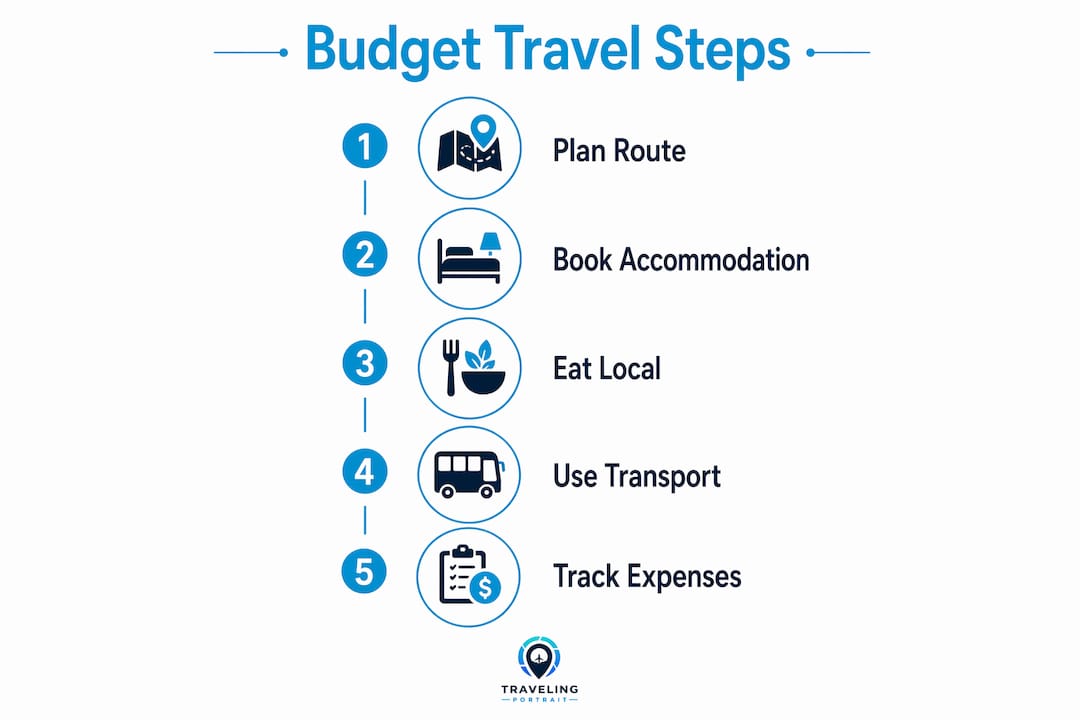
Within those tiers, three specific expense categories drive most of the variation:
- Accommodation : A hostel dorm bed runs $5–$8 per night in South and Southeast Asia versus roughly $50 in Norway or Switzerland. A three-star hotel in Southeast Asia costs $30–$40; the same comfort level in the Nordics runs $200–$230.
- Food : Street meals in Thailand cost $1.50–$3; a sit-down tourist restaurant charges $8–$18 for the same dish. In Mexico, street tacos run $3–$8 versus $15-plus at a sit-down spot near the main sights.
- Local transport : Public transit in Thailand runs about $3 per day; taxis for the same distances cost $12 or more.
The regional price differences within continents are just as striking as the differences between them. In Europe, Albania ($40/day budget) and Switzerland ($150–$250/day budget) are on the same continent but worlds apart in cost. Southeast Asia has its own spread: Japan sits at $75–$90/day while Vietnam comes in at $30/day. Choosing the country, not just the continent, is where the real budget work happens.
What shifts your budget between tiers:
- Sleeping in a dorm vs. a private room can double your accommodation cost in the same city
- Eating at street stalls vs. tourist restaurants triples or quadruples your food spend
- Taking overnight buses or trains instead of flights eliminates both a transport cost and a night’s accommodation
- Booking activities through local operators rather than hotel desks often cuts prices by 30–50%
What actually drives your total travel costs
Destination choice moves your budget more than any other single decision, often by a factor of five or six. A backpacker day in Thailand or Mexico runs $25–$40; the same standard in Switzerland costs $150–$250. No packing hack or loyalty point scheme closes a gap that size.
Here are the major levers, roughly in order of impact:
- Destination and region mix : The ratio of cheap-to-expensive regions in your itinerary determines your baseline more than anything else. Four weeks in Australia costs more than four months in Southeast Asia.
- Travel pace : Moving every two or three days means paying for transport twice a week. Settling into a city for a month means paying once and often negotiating a lower monthly rent than nightly hostel rates.
- Seasonality : Traveling off-season can cut flight and accommodation costs by 40–60% compared to peak prices. Thailand in the June-to-September low season runs at about 0.8 times baseline; December holidays push it to 1.3 times. Shoulder season, a few weeks either side of peak, captures most of that discount while the weather still holds.
- Accommodation type : Dorm beds run 40–60% cheaper than three-star hotels in the same city. In cheap countries the gap is a few dollars; in expensive ones it can top $100 a night.
- Food choices : Eating where locals eat rather than where tourists queue cuts meal costs by three to five times without sacrificing quality.
- Transport mode : Budget airlines, overnight buses, and local trains cost a fraction of taxis and private transfers. The pattern holds almost everywhere: the tourist-default option costs three to five times what locals pay for the same trip.
- Visas and entry fees : Visa costs vary wildly by destination and nationality. Budget $100–$300 for a year-long multi-continent trip, though some regions (like Southeast Asia for Americans) offer visa-free or low-cost e-visa entry.
- Travel insurance : A solid policy for a year of international travel typically runs $400–$600. Skipping it is a false economy, especially for long-term travelers.
- Health and vaccinations : Budget roughly $250 for recommended vaccines (yellow fever, hepatitis A/B, boosters) before a major multi-continent trip.
- Safety and flexibility buffers : Unexpected costs, missed flights, and medical surprises are inevitable over 6–12 months. A 10–15% buffer on top of your planned budget is not paranoia; it’s just honest planning.
Smart budgeting strategies that actually work
The travelers who pull off long-term multi-continent trips without blowing their budget don’t do it through extreme frugality. They do it by making a handful of structural decisions that change the math entirely.
Build your route around cost, not just curiosity
The single most effective move is weighting your itinerary toward low-cost regions. An 80/20 cheap-heavy route (mostly Southeast Asia, South Asia, and Latin America) costs $6,000–$7,000 less per year than a 60/40 mixed route. That’s not a small trim. That’s the difference between a $13,000 year and a $20,000 one, and it has nothing to do with skipping coffee or cooking every meal.
Book flights as independent segments, not round-the-world tickets
Open-jaw and independently booked multi-leg flights consistently undercut round-the-world alliance tickets, especially when you leverage regional low-cost carriers. A worked example: seven paid segments across four continents, nine flying legs, total base fare of $1,495, using WestJet, Vueling, Ryanair, Sichuan Airlines, AirAsia, Jetstar, and Air Canada. The key tactics:
- Book each segment on its strongest market rather than one high-cost global ticket
- Use flexible dates; shifting departure by a few days often cuts fares dramatically
- Accept longer stopovers; an overnight in a hub city is usually cheaper than a fast connection
- Travel carry-on only to avoid checked baggage fees on budget carriers
- Compare nearby airports; flying into Milan instead of Rome, or landing in a secondary hub, can cut the fare on a long-haul leg
Use accommodation strategies that compound over time
Booking a private room for a month almost always costs less per night than booking a hostel dorm week by week. Long-term stays unlock negotiated rates, especially in Southeast Asia and Latin America where landlords prefer a reliable tenant over nightly turnover. Platforms like Airbnb, local Facebook housing groups, and direct guesthouse negotiations all work. Advance booking helps in peak season; showing up in person works better in shoulder and low seasons when hosts are motivated.

Eat like a local, not like a tourist
The further the menu sits from the main tourist drag and the closer it is to where locals actually queue, the lower the price and the higher the quality. Street food in Thailand at $1.50–$3 a meal versus $8–$18 at a restaurant isn’t a compromise. It’s often the better meal.
Leverage local and regional transport
Overnight buses and trains in Southeast Asia, South Asia, and Latin America double as accommodation, saving both a night’s hostel cost and a daytime travel expense. Rail passes in Europe (like Eurail) make sense for heavy travel schedules; point-to-point tickets beat passes for shorter stints. Scooter rentals in Asia at $3–$7 per day give you a full day of freedom for less than a single taxi ride.
Time your moves around shoulder season
Peak season pricing isn’t just slightly higher. It’s 40–60% higher on flights and accommodation. Shoulder season, the few weeks before and after peak, captures most of the discount while keeping the experience intact. Thailand in October, Portugal in April, Japan in late November: all of these hit the sweet spot between good weather and lower prices.
Track every expense from day one
Apps like Trail Wallet, TravelSpend, or even a simple spreadsheet let you see exactly where your money goes. Most long-term travelers who blow their budget don’t do it in one dramatic splurge. They do it through dozens of small decisions that never get reviewed. Checking your daily spend every evening takes two minutes and keeps you honest.
Navigate visas and insurance without surprises
Research visa requirements at least three months before arrival in each country. Some visas (India e-visa, Turkey e-visa) are quick and cheap online. Others require in-person applications, supporting documents, or significant lead time. Factor visa costs into your budget by region, not as an afterthought. For insurance, SafetyWing and World Nomads are the two most commonly used options among long-term travelers; compare coverage for adventure activities if that’s part of your plan.
How to plan your multi-continent trip step by step
Good planning is what separates a trip that stays on budget from one that hemorrhages cash in the first month. Here’s the sequence that works:
-
Set your total budget and timeline first. Decide how much you have and how long you want to travel before you pick a single destination. A $15,000 budget over 12 months means roughly $1,250/month, which is very comfortable in Southeast Asia and tight in Western Europe.
-
Choose your continent mix based on cost. Research daily costs by region and build a rough itinerary that weights your time toward affordable areas. Use the regional cost data above as your baseline, then check specific countries. Explore destination options to match your interests with your budget.
-
Book intercontinental flights first. These are your biggest single expenses and the hardest to change. Search 4–12 weeks before travel, use flexible dates, and compare nearby departure airports. Book each segment independently rather than as a single alliance ticket.
-
Plan accommodation in broad strokes, not day by day. Know which cities you’ll base yourself in and for roughly how long. Book the first few nights in each new country in advance; after that, negotiate in person or book week by week once you know the vibe.
-
Research visa requirements for every country on your list. Some visas need to be arranged months ahead. Others are available on arrival or as quick e-visas. Build a visa timeline and budget into your planning spreadsheet.
-
Get vaccinations sorted at least 6–8 weeks before departure. Some vaccines (hepatitis A/B, typhoid, yellow fever) require multiple doses or a waiting period. A travel health clinic can give you a personalized recommendation based on your specific itinerary.
-
Secure travel insurance before your first flight. Don’t leave this until the last minute. Read the fine print on adventure activity coverage, medical evacuation limits, and trip interruption clauses.
-
Pack light and pack right. Carry-on only saves you checked baggage fees on every budget airline leg, speeds up airport transitions, and makes overland travel far less painful. The right travel gear makes a real difference over months on the road.
-
Set up your finances for international travel. A fee-free debit card (Charles Schwab’s investor checking account reimburses all ATM fees worldwide; Wise and Revolut work well for currency conversion) saves you real money over months of withdrawals. Notify your bank before departure and keep a backup card in a separate bag.
-
Build a flexible itinerary with buffer weeks. Don’t schedule every day. Leave two or three unplanned weeks per continent for places you love and want to stay longer, or for recovery when things go sideways. Rigidity is expensive when you’re forced to book last-minute flights because your schedule has no slack.
Pro Tip: Monitor currency exchange rates with an app like Wise or XE Currency before making large ATM withdrawals. Pulling cash when your home currency is strong against the local currency can save you 5–10% on every transaction.
How slow travel can cut your costs in half
The single most powerful budget strategy for long-term travelers isn’t finding the cheapest hostel or eating only street food. It’s slowing down.
Travelers who stay more than seven weeks in one destination spend roughly half as much as those who move every two or three weeks. That’s not a marginal improvement. That’s the difference between a $20,000 year and a $10,000 one, driven almost entirely by reduced transport costs and cheaper accommodation rates.
The math behind slow travel: A traveler moving every two to three days pays for a bus or flight roughly twice a week. Someone who settles into a city for a month pays for that transport once and often negotiates a lower monthly rent than the nightly hostel rate. Slow travel doesn’t mean doing less. It means spending more time in each place, which almost always costs less per day than rushing through it.
Here’s what actually changes when you slow down:
- Transport costs collapse. Instead of five or six internal flights per month, you might take one. Overland moves between nearby cities cost a fraction of flying.
- Accommodation rates drop. Monthly rentals in Southeast Asia and Latin America often run 40–60% less per night than weekly hostel rates. A $15/night dorm becomes a $600/month private room, which is $20/night for a space that’s actually yours.
- Food costs fall naturally. When you stay somewhere for weeks, you find the local market, the neighborhood restaurant where nobody speaks English, and the grocery store. You stop eating at tourist-facing spots by default.
- You negotiate better deals. Landlords, tour operators, and local guides all respond to the traveler who’s staying for a while. A month-long commitment opens doors that a three-day visit never does.
The common misconception is that slow travel means being frugal or missing out. It’s actually the opposite. Staying six weeks in Chiang Mai instead of three days gives you time to take a cooking class, rent a scooter and explore the surrounding mountains, and actually get to know the city. You spend less and experience more.
Pro Tip: When planning a slow travel route, identify two or three “base cities” per continent where monthly rentals are cheap and easy to find. Chiang Mai in Thailand, Medellín in Colombia, and Tbilisi in Georgia are three of the best-known examples, each offering excellent value, good infrastructure, and a strong community of long-term travelers.

How long should you spend on each continent?
One of the most common planning mistakes is trying to see too many countries too quickly. Here are realistic minimum timelines that give you enough depth without burning through your transport budget:
Southeast Asia: 2–4 months
Two months is the minimum to cover a meaningful chunk of the region without feeling rushed. Thailand, Vietnam, Cambodia, and Laos form a natural overland circuit that most travelers complete in 8–12 weeks. Add Indonesia or the Philippines and you’re looking at 3–4 months. The region rewards slow travel more than almost anywhere else, and the low daily costs mean staying longer actually makes financial sense.
Latin America: 2–3 months
Mexico and Central America (Guatemala, Nicaragua, Costa Rica, Panama) form one overland corridor; South America (Colombia, Ecuador, Peru, Bolivia) forms another. Doing both in one trip requires either a flight or a lot of patience. Two months covers one corridor well; three months lets you do both without feeling like you’re on a bus every other day.
Europe: 1–3 months
Europe is the most expensive continent for budget travelers, so the strategic move is to spend less time here relative to Asia and Latin America. One month in the Balkans (Albania, North Macedonia, Serbia, Bulgaria) gives you a genuine European experience at $35–$55/day. Add Portugal and Spain for another month and you’re still in the affordable half of Europe. Western Europe deserves at least two weeks but rarely justifies more than a month on a tight budget. Check out European destinations for more on where to focus your time.
South Asia (India, Nepal, Sri Lanka): 1–2 months
India alone could absorb six months without running out of things to see, but one to two months gives you a solid north-to-south or east-to-west circuit. Nepal adds two to three weeks for trekking. Sri Lanka is a natural add-on at two to three weeks. Daily costs in this region are among the lowest on earth, at $25–$35/day for a comfortable backpacker experience.
East Asia (Japan, China, Taiwan): 2–4 weeks per country
Japan is the most expensive country in East Asia at $75–$90/day, but it’s also one of the most rewarding. Two to three weeks is the sweet spot for a first visit. China and Taiwan are more affordable and could each absorb a month comfortably. This region works best as a focused leg rather than a multi-month base.
Africa: 1–3 months
North Africa (Morocco, Egypt) is the most accessible and affordable entry point, at $35–$50/day. East Africa (Kenya, Tanzania) is pricier but spectacular, especially for wildlife. Budget for internal transport costs in Africa to be higher than in Asia or Latin America; distances are vast and infrastructure varies widely.
Safety tips every long-term budget traveler needs
Traveling cheap doesn’t mean traveling carelessly. Long-term budget travelers face a specific set of risks that the occasional vacationer doesn’t, and a few smart habits make a real difference.
Secure your money across multiple accounts and locations
Never keep all your cash and cards in one place. A money belt worn under your clothes works for airports and crowded markets. Day-to-day, a front-pocket wallet with only what you need for the day is smarter than carrying your full stash. Keep a backup debit card and emergency cash (a few hundred dollars in small bills) locked in your accommodation or hidden in your bag.
Use reputable accommodation, especially when you’re new to a city
Your first night in a new city is when you’re most vulnerable: tired, disoriented, and carrying all your gear. Book your first night in advance at a well-reviewed hostel or guesthouse. Once you know the neighborhood, you can move to cheaper options. Reading recent reviews on booking platforms is worth the five minutes it takes.
Stay connected and share your itinerary
A local SIM card with data is one of the best safety investments you can make. It costs $5–$15 in most countries and gives you access to maps, translation apps, and emergency contacts. Share your rough itinerary with someone at home and check in regularly, especially when you’re heading somewhere remote.
Know the common scams in each region
Every popular travel destination has its own set of tourist scams, and they’re usually well-documented online. The tuk-tuk driver who wants to take you to a “better” temple, the friendly local who insists on showing you a gem shop, the taxi without a meter: these are predictable and avoidable with a quick Google search before you arrive. Avoiding common trip mistakes before you leave saves you real money and stress on the road.
Get proper travel insurance and actually read it
A policy that doesn’t cover adventure activities, pre-existing conditions, or medical evacuation is a policy that might not cover you when you need it most. Read the exclusions before you buy. For long-term travelers, SafetyWing’s nomad insurance and World Nomads are the most commonly used options; both cover a wide range of activities and offer monthly billing, which suits an open-ended itinerary.
Trust your instincts and don’t be afraid to spend a little more on safety
Budget travel is about making smart trade-offs, not about being cheap at any cost. If a guesthouse feels off, pay the extra $5 for the one with better reviews. If a bus company has a reputation for accidents, take the train. If a neighborhood feels sketchy after dark, take a rideshare. The money you save by ignoring your gut is rarely worth it.
Keep digital copies of all important documents
Passport, visa, travel insurance policy, vaccination records, emergency contacts: store copies in a secure cloud service (Google Drive, Dropbox) and email them to yourself. If your bag gets stolen or your passport goes missing, having digital copies makes the replacement process dramatically faster.
Key Takeaways
Budget travel across continents is achievable on $9,000–$10,500 for six months (plus $1,800–$2,500 for flights between regions) or $11,000–$20,000 for a full year depending on the ratio of cheaper to pricier regions, with region mix being the single most powerful lever on total cost.
| Point | Details |
|---|---|
| Region mix drives total cost | A 60/40 cheap-to-pricier split costs $17,000–$20,000/year; an 80/20 cheap-heavy route drops to $11,000–$13,000. |
| Slow travel halves daily costs | Staying 7+ weeks per destination cuts expenses by up to 50% through lower transport and negotiated accommodation rates. |
| Book flights as independent segments | Seven paid segments across four continents can total as little as $1,495 base fare using regional low-cost carriers. |
| Off-season travel saves 40–60% | Flights and accommodation cost 40–60% less in low season versus peak, with shoulder season offering the best value-to-experience ratio. |
| Street food cuts meal costs 3–5x | Eating local street food ($1.50–$3 in Thailand) versus tourist restaurants ($8–$18) is one of the fastest ways to reduce daily spend. |
Recommended
Other Posts You Might Like