

How to Prepare Physically for Adventure Travel
Physical preparation for adventure travel is defined as a structured conditioning program that builds cardiovascular endurance, muscular strength, and mobility to meet the demands of rugged outdoor activities. Without it, even moderately challenging trips can result in injury, exhaustion, or a trip you spend recovering from instead of enjoying. The good news? You don’t need to be an elite athlete. You need a smart, consistent plan. Most experts recommend starting 8–12 weeks before your departure date, giving your body enough time to adapt gradually without burning out. This guide breaks down exactly how to prepare physically for adventure travel, from your first training week to the day you lace up your boots on the trail.
How to prepare physically for adventure travel: where to start
The single most important decision you’ll make is when to start training. Experts recommend 8–12 weeks of lead time before your trip. That window gives your muscles, tendons, and joints time to adapt without being rushed into overuse injuries.
Start with an honest assessment of your current fitness level. Can you walk briskly for 45 minutes without stopping? Can you carry a loaded daypack up a flight of stairs without your knees complaining? Your answers tell you where your baseline sits, and that baseline shapes everything that follows.
Here’s a simple way to structure your first four weeks:
- Week 1–2: Establish your baseline. Walk 30–45 minutes three times per week. Add two short bodyweight strength sessions.
- Week 3–4: Increase duration by no more than 15% per week. Add light pack weight (around 10–15 lbs) to one walk per week.
- Week 5–8: Introduce terrain variety. Walk hills, stairs, or trails. Increase pack weight gradually toward your expected trip load.
- Week 9–11: Peak training. Simulate your trip conditions as closely as possible, including distance, elevation, and pack weight.
- Week 12: Taper. Reduce volume by 30–40% to arrive at your trip rested and sharp.
Increasing mileage or load by more than 15% per week is the fastest route to a stress fracture or tendon problem. Slow and steady genuinely wins this race.
Pro Tip: Write your training plan on paper or in a notes app before week one starts. Travelers who plan workouts in advance are far more likely to follow through when life gets busy.
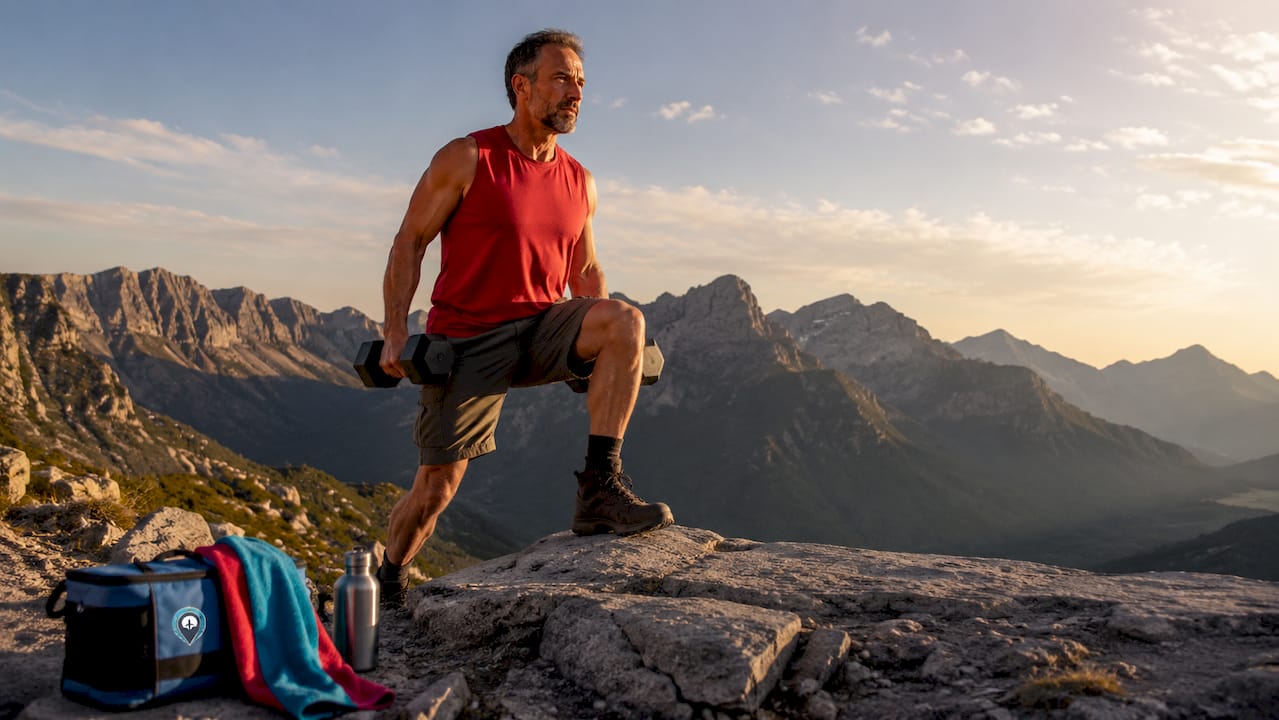
What cardio and strength exercises best prepare you for outdoor adventures?
General gym fitness does not equal adventure-specific conditioning. A person who crushes it on the elliptical can still struggle badly on a rocky trail with a 30 lb pack. The terrain, the load, and the duration are all different. Your training needs to reflect that.
For cardiovascular endurance, aim for 2–3 cardio sessions per week. The best options for adventure-specific fitness include:
- Hiking with a loaded pack: The most direct carryover to trail conditions. Start at 20 lbs and build from there.
- Stair climbing: Builds the exact quad and glute strength you need for ascents. Use a building stairwell or a StairMaster.
- Cycling: Low impact on joints while building serious leg endurance. Great for active recovery days too.
- Swimming: Builds full-body cardiovascular capacity and is easy on the body during high-volume training weeks.
For strength, two sessions per week is the target. Focus on legs, hips, core, back, and shoulders. Those are the muscle groups that carry you and your gear across difficult terrain.
Key strength exercises to include:
- Goblet squats and lunges: Build the quad and glute strength needed for sustained uphill walking.
- Step-ups: Single-leg stability exercises like step-ups train the micro-adjustments your ankles and knees make on uneven ground. They directly reduce trail injury risk.
- Deadlifts (light to moderate): Strengthen the posterior chain, which takes the load when you’re carrying a heavy pack for hours.
- Planks and dead bugs: Core stability keeps your spine protected under pack weight.
- Shoulder press and rows: Your shoulders and upper back carry the pack straps. Weak shoulders mean pain by day two.
Pro Tip: Train in the shoes you plan to wear on your trip. Breaking in footwear during training prevents the blisters and hot spots that ruin the first two days of any trek.
How to balance recovery, nutrition, and mobility in your training
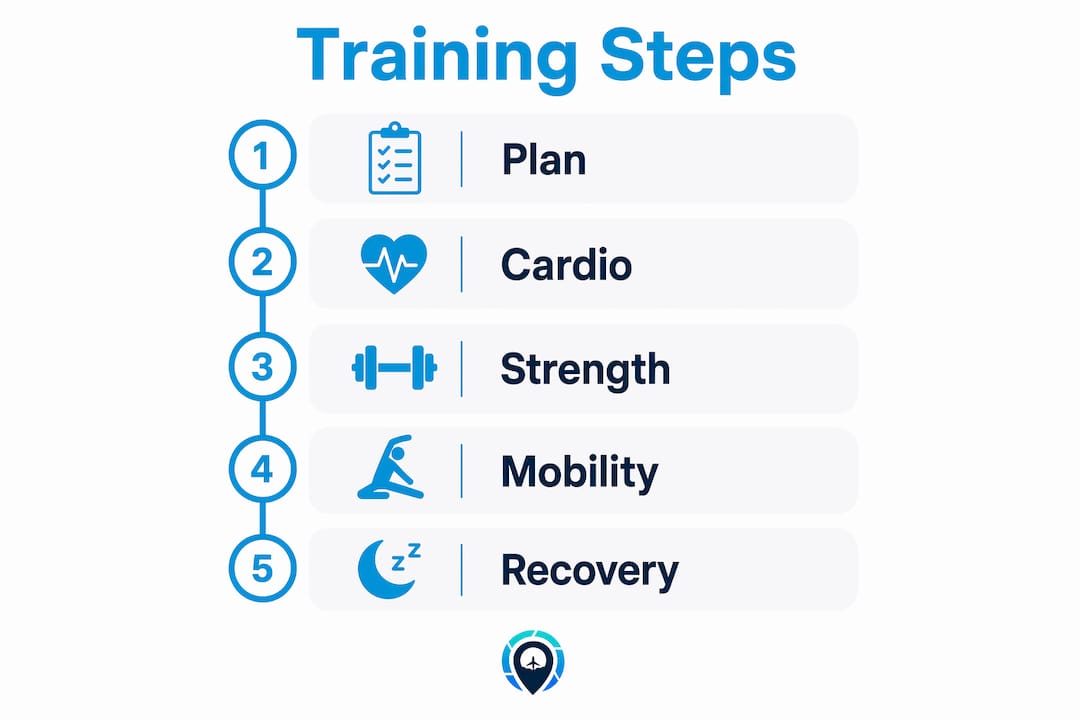
Recovery is not downtime. Your body strengthens during rest, not during the workout itself. Skipping rest days doesn’t make you tougher. It makes you slower to adapt and more likely to get hurt.
Plan at least one full rest day per week. Every three to four weeks, schedule a deload week where you cut training volume by roughly 30–40%. Deload weeks allow tendons and joints to catch up with the stress you’ve been placing on them. Tendons adapt more slowly than muscles, and ignoring that fact is how people arrive at their trip with a nagging Achilles or knee problem.
Nutrition and hydration are active parts of your training program, not afterthoughts. Proper fueling supports recovery and energy between sessions. Prioritize protein within two hours of strength sessions to support muscle repair. Eat enough carbohydrates to fuel your longer cardio sessions. Drink water consistently throughout the day, not just during workouts.
Mobility work rounds out the program. Add these to your daily routine:
- Hip flexor stretches: Tight hip flexors are the hidden cause of lower back pain on long hiking days.
- Calf and ankle circles: Ankle mobility directly affects your stability on uneven terrain.
- Thoracic spine rotations: Keeps your upper back mobile under pack weight.
- Hamstring stretches: Prevents the stiffness that builds up after long descents.
Ten minutes of mobility work each morning costs almost nothing and pays off enormously on day three of a multi-day trek.
How to maintain fitness while traveling and avoid setbacks
Keeping your fitness gains while actually on the road is where most people fall apart. Schedules get unpredictable, gyms disappear, and motivation drops. The fix is simplicity and pre-planning.
Short, consistent bodyweight workouts of 20–30 minutes outperform long, infrequent sessions every time. You don’t need a gym. You need a floor and 20 minutes.
Here’s a travel-friendly routine that requires zero equipment:
- Squats (3 sets of 15): Maintains leg strength and keeps your knees healthy for active days.
- Push-ups (3 sets of 10–15): Keeps your chest, shoulders, and triceps engaged.
- Reverse lunges (3 sets of 10 per leg): Single-leg work that maintains trail-specific stability.
- Plank holds (3 sets of 30–45 seconds): Core maintenance with no equipment needed.
- Glute bridges (3 sets of 15): Protects your lower back and keeps your hips firing correctly.
Reducing decision fatigue by pre-planning workouts is the real secret. Save your workout to your phone before you travel. Lay out your clothes the night before. When the decision is already made, you actually do it.
Common physical preparation mistakes and how to avoid them
Most pre-trip training mistakes fall into a few predictable patterns. Knowing them in advance saves you a lot of pain.
- Ramping up too fast. Increasing your training load by more than 15% per week is the most common cause of overuse injuries. Patience is the strategy.
- Relying only on gym machines. Treadmills and weight machines build general fitness. They don’t replicate the lateral instability, uneven footing, and sustained load of real trail conditions. Get outside.
- Skipping rest days. Rest is where strength is built. Cutting rest to add more training sessions is counterproductive.
- Ignoring uphill and downhill conditioning. Descents are harder on your knees than ascents. Train both directions deliberately. Find hills or use a treadmill incline in both directions.
- Not breaking in your footwear. New boots on day one of a trek are a disaster. Wear your trip shoes during training for at least four to six weeks before departure.
- Neglecting pack training. Carrying a loaded pack changes your gait, your center of gravity, and the muscles under stress. Practice with your actual pack, loaded to your expected trip weight.
The benefits of pre-trip fitness planning go well beyond physical readiness. Travelers who train specifically for their trip report higher enjoyment, fewer injuries, and greater confidence in challenging conditions.
Key Takeaways
Structured physical conditioning that combines endurance, strength, mobility, and recovery is the most effective way to prepare your body for adventure travel demands.
| Point | Details |
|---|---|
| Start 8–12 weeks out | Begin your training program at least 8–12 weeks before departure to allow safe adaptation. |
| Limit weekly increases to 15% | Never increase training volume or pack weight by more than 15% per week to prevent injury. |
| Train for your specific terrain | Include pack training, hill work, and single-leg stability exercises that match your actual trip conditions. |
| Recovery is non-negotiable | Schedule rest days and deload weeks every 3–4 weeks to let tendons and joints catch up. |
| Keep travel workouts simple | Use 20–30 minute bodyweight routines pre-planned on your device to maintain fitness on the road. |
What I’ve learned about training for adventure travel
I’ll be honest with you: the biggest mistake I see travelers make is training hard for six weeks and then arriving at their trip completely wrecked. They pushed too much, rested too little, and showed up with a sore knee or a tight IT band that colored every single day of the experience.
Consistency beats intensity every time. A moderate workout done five days a week for 10 weeks will outperform a brutal program done for three weeks and then abandoned. The body adapts to what you do repeatedly, not to what you do occasionally and aggressively.
The other thing I’d push back on is the idea that physical preparation is purely physical. Mental readiness matters just as much as your cardiovascular fitness when you’re on day four of a multi-day trek and the weather turns. Practicing discomfort during training, pushing through the last mile when you’d rather stop, builds the mental adaptability that keeps you safe and enjoying yourself when conditions get unpredictable.
Tailor your training to your specific trip. A rafting expedition demands different conditioning than a high-altitude trek in the Himalayas. Read the adventure travel guide for your destination and build your program around what that terrain actually asks of your body. Generic fitness is a starting point. Specific preparation is what gets you to the summit.
— Justin Frazier
Plan your adventure with Traveling Portrait
Physical readiness gets you to the trailhead in great shape. The right resources get you everywhere else.
Traveling Portrait has built a library of adventure travel guides, gear recommendations, and destination-specific planning resources to help you go further with more confidence. Whether you’re mapping out your first multi-day trek or planning a photography-focused expedition, the adventure travel resources at Traveling Portrait give you the context to make smart decisions before you leave home. Check out the essential gear checklist to make sure your kit matches the demands of your destination. Your body will be ready. Make sure everything else is too.
FAQ
How early should I start training for an adventure trip?
Most experts recommend starting 8–12 weeks before your departure date. That window allows gradual adaptation and significantly reduces overuse injury risk.
What is the best exercise to prepare for hiking?
Loaded pack walks on varied terrain, combined with step-ups and lunges, are the most effective exercises for hiking preparation. Single-leg stability work directly addresses the balance demands of uneven trail surfaces.
How do I stay fit while traveling with no gym access?
Short bodyweight workouts of 20–30 minutes done consistently outperform infrequent gym sessions. Pre-plan your routine on your phone and lay out your clothes the night before to remove friction.
How much weight should I train with in my pack?
Start around 20 lbs and increase gradually, never exceeding a 15% load increase per week. Your training pack weight should eventually match your expected trip pack weight.
Does mental preparation matter for adventure travel?
Mental readiness directly impacts safety and enjoyment on multi-day trips. Practicing discomfort during training builds the adaptability you need when conditions on the trail become unpredictable.
Recommended
Other Posts You Might Like