Stand Here · Field guide 01
The Subway Cave is a sandstone alcove tucked into a side canyon of Boynton Canyon, west of Sedona. Its curved, tunnel-like walls frame a window straight out across the canyon, and a narrow ledge runs along the lip. It's one of the most photographed places in Arizona and one of the least signed. This is the guide I wanted the first time I went: exactly where it is, where to stand for the frame, and when the light works.
At a glance
- The cave: 34.93246, -111.86309 (Google Maps · OpenStreetMap)
- Trailhead: Boynton Canyon Trailhead, 34.90762, -111.84915
- The hike: about 5 miles round trip, roughly 550–600 ft of climbing. Allow 2.5 to 3.5 hours with time at the cave.
- Best light in the cave: the first few hours after sunrise. The cave faces east.
- Best light outside it: late afternoon on the walk out, when the canyon walls warm up.
- Best time to go: a weekday in spring, fall or winter, on the trail before sunrise.
- Parking: Red Rock Pass ($5 a day) or an America the Beautiful pass. About 25 spaces, often full by 7:30 a.m. in spring and fall.
- Not allowed: drones (this is a wilderness area), and touching or climbing on the Sinagua walls.
The photograph
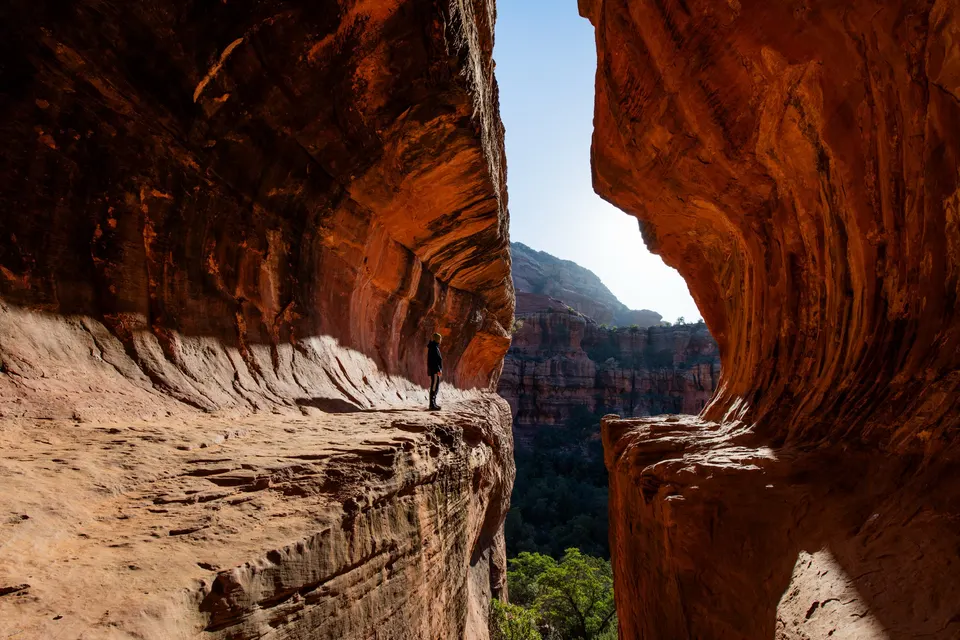
This is the frame people hike five miles for: the walls curve in on both sides like the inside of a wave, the ledge leads your eye to the opening, and the far wall of Boynton Canyon fills the window. A person standing on the ledge gives it scale. Without one, it's hard to tell whether the cave is ten feet tall or a hundred.
Where to stand
Once you're up into the cave, keep going to the back of the alcove and turn around. That's the view. From there:
- For the classic frame, stand toward the back and center yourself on the opening, so both curved walls frame the canyon evenly. Go wide: the whole point is the curve, and a phone's standard wide lens or a 14–24mm on a full-frame camera will hold both sides.
- For a person in the shot, put them out on the ledge near the mouth, where they're silhouetted against the bright canyon, then step back until the walls wrap around them.
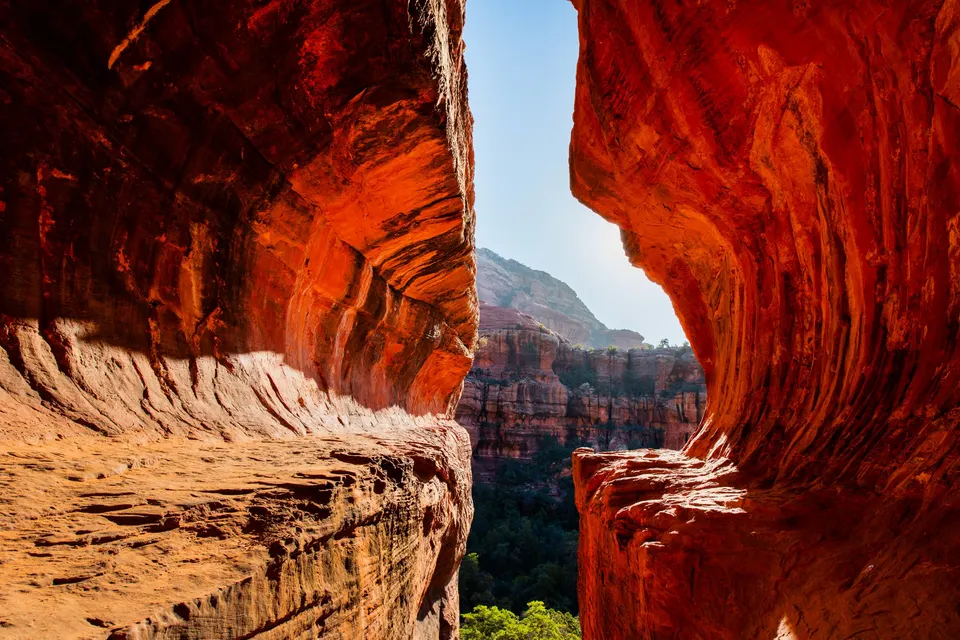
- For something different, walk to one side and let one wall sweep across the frame, as in the photo below. It shows more of the cave's ribbed texture and less of the view.
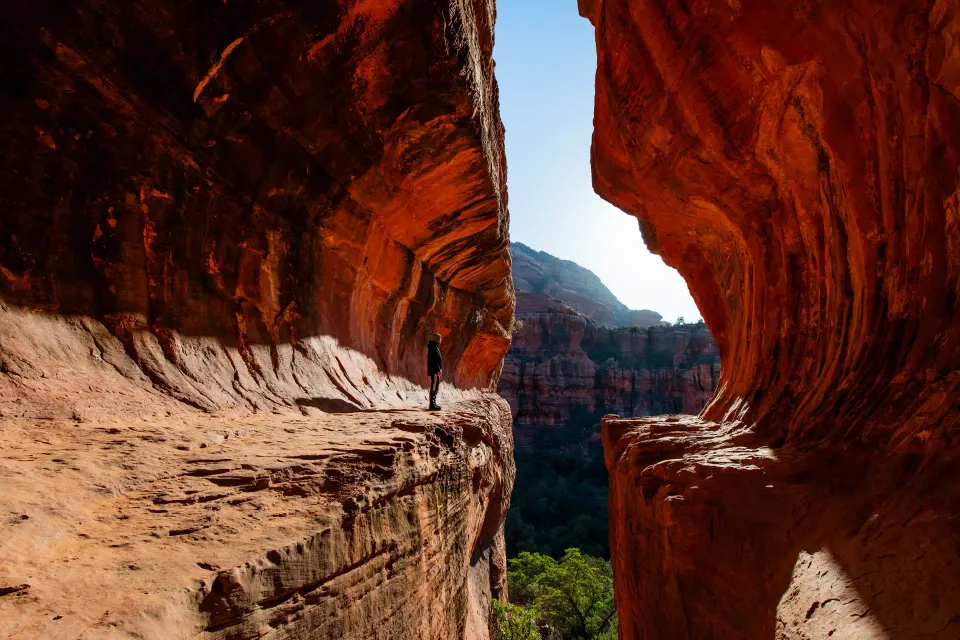
Keep the ledge in mind as you frame: it's narrow, with a real drop below it. Compose from somewhere stable and don't back up while looking through the viewfinder.
When the light works: two different photographs
Morning: the cave glows
The cave faces east, so for the first few hours after sunrise sunlight comes straight into the mouth and bounces around the curved walls. That's when the sandstone turns the deep, glowing orange you see in most photos of this place. Get there early in that window: as the sun climbs, the light leaves the mouth and the cave falls into shade.
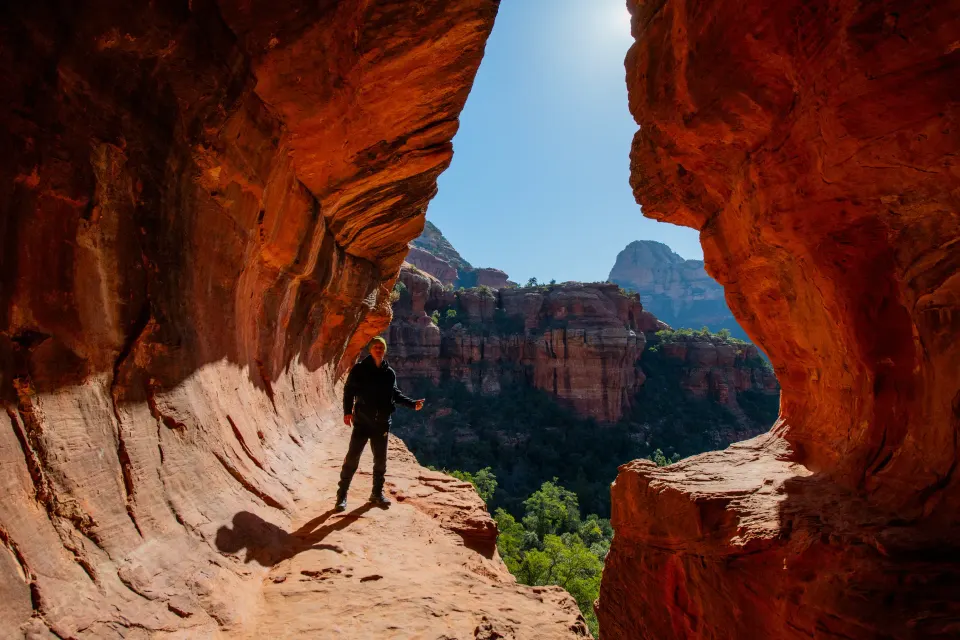
Arizona doesn't change its clocks for daylight saving time, so check the sunrise time for your date before you set the alarm. Start walking in the dark if you want the first light in the cave.
Late afternoon and sunset: the canyon glows
By afternoon the cave is in open shade. That's not a bad thing. The light inside is soft and even, which is kinder to faces than harsh morning sun, and the contrast between the shaded walls and the sunlit canyon beyond is easier to manage. The bigger reward comes on the walk out, when the sun drops and the cliffs of Boynton Canyon light up red and gold.
If you stay for sunset, be off the scramble before it gets dark and carry a headlamp for the 2.5 miles back to the car. The spur trail is unmarked and easy to lose at night.
Midday
The hardest light, and the longest lines. If midday is all you have, shoot the cave's texture and the shaded walls rather than the bright window, which will blow out.
How to find it
- Drive to the Boynton Canyon Trailhead. From Highway 89A in West Sedona, take Dry Creek Road north (it becomes Boynton Pass Road), then turn right onto Boynton Canyon Road. The trailhead is on the right.
- Hike Boynton Canyon Trail for about 2 miles. It's well signed and climbs gently through juniper and pine along the base of the cliffs.
- Find the alligator juniper. Around the 2-mile mark, watch for a big juniper on the left side of the trail with bark cracked into squares like alligator skin. The unofficial spur leaves the main trail on the right, roughly opposite the tree. Some trackers put the turn closer to 2.4 miles, so if you've gone well past the 2-mile mark, check your GPS.
- Follow the spur about 0.3–0.4 miles up toward the cliffs. The cave sits in the rock above you.
The pin above comes from OpenStreetMap, where the cave entrance is mapped. Download an offline map or GPS track before you go, and don't count on cell signal in the canyon. If you can't find the turn, don't bushwhack: the main canyon trail is a good hike on its own.
Getting up into the cave
The last part is a scramble up smooth sandstone. Most people go straight up the steep chute in the middle, which is the trickiest bit of the whole hike. There's an easier option that loops in along a ledge from the left. If you're not comfortable on slickrock or with heights, take the ledge, or enjoy the view from below. Wear shoes with real grip: the sandstone is polished smooth by thousands of feet.
Crowds and parking
The Subway Cave is not a secret anymore. On spring and fall weekends people line up at the chute, and later in the day the wait to get into the cave can stretch to an hour. Everyone gets the same few minutes with the view, so arriving first matters more here than almost anywhere in Sedona.
- Go on a weekday, ideally in winter, when the trail is quietest.
- Be at the trailhead before sunrise. The lot is small (about 25 spaces) and fills by around 7:30 a.m. in spring and fall.
- Overflow parking is along Boynton Pass Road, which adds a quarter mile or more each way.
- There's no shuttle. The free Sedona Shuttle doesn't currently serve this trailhead, so plan to drive.
Respect the site
The cliff dwellings beside the cave were built by the Sinagua roughly 900 years ago, and Boynton Canyon is sacred to the Yavapai and Apache people. Treat it that way:
- Don't climb, sit or stand on the walls or dwellings, and don't touch the walls or any rock art.
- Take nothing. Removing artifacts is a federal crime under the Archaeological Resources Protection Act.
- No drones. Boynton Canyon is in the Red Rock–Secret Mountain Wilderness, where drones can't take off or land.
- Keep your voice down, pack out everything, and give the next person their turn at the view.
What to bring
- A wide lens. A phone's standard wide camera works fine; on a camera, 14–24mm on full frame.
- Water: at least 2 liters each, more from May to September.
- Shoes with grip for the slickrock chute.
- A headlamp if you're starting before dawn or staying for sunset.
- Your Red Rock Pass, bought online or at the trailhead kiosk.
On the map
The marker is the cave. The trailhead is at the bottom right, where Boynton Canyon Road ends. Open the larger map. Map data © OpenStreetMap contributors.
Keep exploring Sedona and the Southwest
- Hiking in Sedona: Cathedral Rock, Devil's Bridge, West Fork and more trails to pair with this one
- Arizona slot canyons: Antelope, Buckskin Gulch and Wire Pass, about two and a half hours north
- Horseshoe Bend at sunset: timing, light and photography tips
Want photos of yourself in Sedona's red rock?
I take small private groups (1–4 guests) on a golden-hour hike to a red rock lookout above Sedona, timed so the valley lights up as you arrive. You walk and take it in; I photograph you there, and you get 25–40 edited photos within a week. $350 per group.
FAQ
Where exactly is the Subway Cave in Sedona?
In a side canyon off Boynton Canyon, west of Sedona, at about 34.93246, -111.86309. You reach it from the Boynton Canyon Trailhead: about 2 miles up the main trail, then right onto an unmarked spur opposite a large alligator juniper.
What time of day is best for the Subway Cave?
Early morning for the glowing orange walls, because the cave faces east and catches the sun for a few hours after sunrise. By afternoon it's in shade, which gives softer light for portraits, and the canyon cliffs light up around sunset on the walk out.
How long is the hike to the Subway Cave?
About 5 miles round trip with roughly 550–600 feet of climbing. Allow 2.5 to 3.5 hours, more if there's a line at the cave.
Do you need a permit for the Subway Cave?
No permit, but you need a Red Rock Pass ($5 a day) or an America the Beautiful pass to park at the Boynton Canyon Trailhead.
Can you fly a drone at the Subway Cave?
No. Boynton Canyon is in the Red Rock–Secret Mountain Wilderness, where drones can't take off or land.